Whether you want to learn a different language for work, travel or personal enrichment, there is an AI-powered tool waiting to help you along the way.
Gone are the days of relying on expensive textbooks or rigid classroom schedules. Today, your smartphone can serve as your personal language teacher. The dream of picking up a new language has never been more accessible, thanks to the increasing number of digital platforms and some amazing advancements in artificial intelligence. Whether you want to learn a different language for work, travel or personal enrichment, there is an AI-powered tool waiting to help you along the way.
But with countless options flooding the market, where should you begin? The sheer number of choices available today creates a "choice paralysis" over which language learning tool may be the best. That's exactly why we compiled a list of the best language learning apps 2026 has to offer.
This guide will cover the top language learning apps for various styles and preferences to help you navigate the noise. We will break down the pros and cons of each option, exploring everything from no-cost, gamified applications to immersive AI tutors and live coaching platforms. Whether you are looking to learn a language for fun, moving to another country, or simply want to impress your boss, there is a perfect digital partner for your journey.
Should You Use Apps for Language Learning?
So, what is the ideal language app for you? The answer depends on several factors. Choosing the best language learning app usually depends on your learning style and goals, your budget and how much time you can dedicate. Here are some key considerations:
• Your starting level (For example: If you barely know the words, then practicing an accent probably won’t help you very much.)
• How committed you are to learning (Do you often start and then quit? Some apps are specifically designed to help you build a habit.)
• Available budget
• Available time and schedule (Do you prefer shorter or longer learning sessions?)
• Your specific goals (Maybe you don’t want to speak Japanese. Maybe you only want to understand it enough to watch anime without subtitles.)
• Your learning style (Are you an auditory, visual, or kinesthetic learner?)
Using apps comes with significant benefits. Because they are available anytime and anywhere, you can easily squeeze language lessons into a busy schedule. They are also highly cost-efficient for beginners who are just testing the waters. Furthermore, apps provide a pressure-free environment that helps shy people build enough baseline speaking confidence before they take the leap to hire a human tutor. For anyone who wants to learn a new language without a heavy financial commitment, a language-learning app is an excellent starting point.
Apps are excellent for building vocabulary and language skills, but real conversations demand spontaneous human interaction.
However, no app is perfect. No single tool will make you fluent without real-world practice. Apps are excellent for building vocabulary and language skills, but real conversations demand spontaneous human interaction. The right language learning platform can help you learn the fundamentals and reach your learning goals, but the best way to learn remains a combination of digital tools and live practice.
Top 10 Best Language Learning Apps
We have researched the top contenders in this space to bring you this list. To help you find the right digital partner, we evaluated these tools to uncover the available options for mastering grammar, expanding word knowledge, improving speaking skills and leveraging advanced AI integration. Among language learning apps on the market today, here are our top picks.
Duolingo: Best Free Language Learning App
Pros: Highly engaging gamified design, completely free access to all languages (40+), bite-sized lessons that won't overwhelm you.
Cons: Limited grammar explanations, repetitive phrasing and difficulties when practicing speaking.
Pricing: Free basic version; Super Duolingo starts at ~$6.99/month, and Duolingo Max (with AI features) is $30/month.
Duolingo is often funny, silly, and informal. It goes to great lengths to connect with you.
Duolingo is easily the most accessible platform on the market, offering bite-sized, gamified lessons across more than 40 languages. It has an engaging, game-like design with streaks, leaderboards and experience points to keep the users coming back. This approach makes it fun for beginners and casual users who want daily practice to become a habit. Duolingo's most impressive feature is its accessibility: the app is free and gives users access to all core languages. For those wanting more, premium tiers add advanced features like AI-powered roleplay, making Duolingo one of the best language learning apps for beginners who want to start without spending a dime.
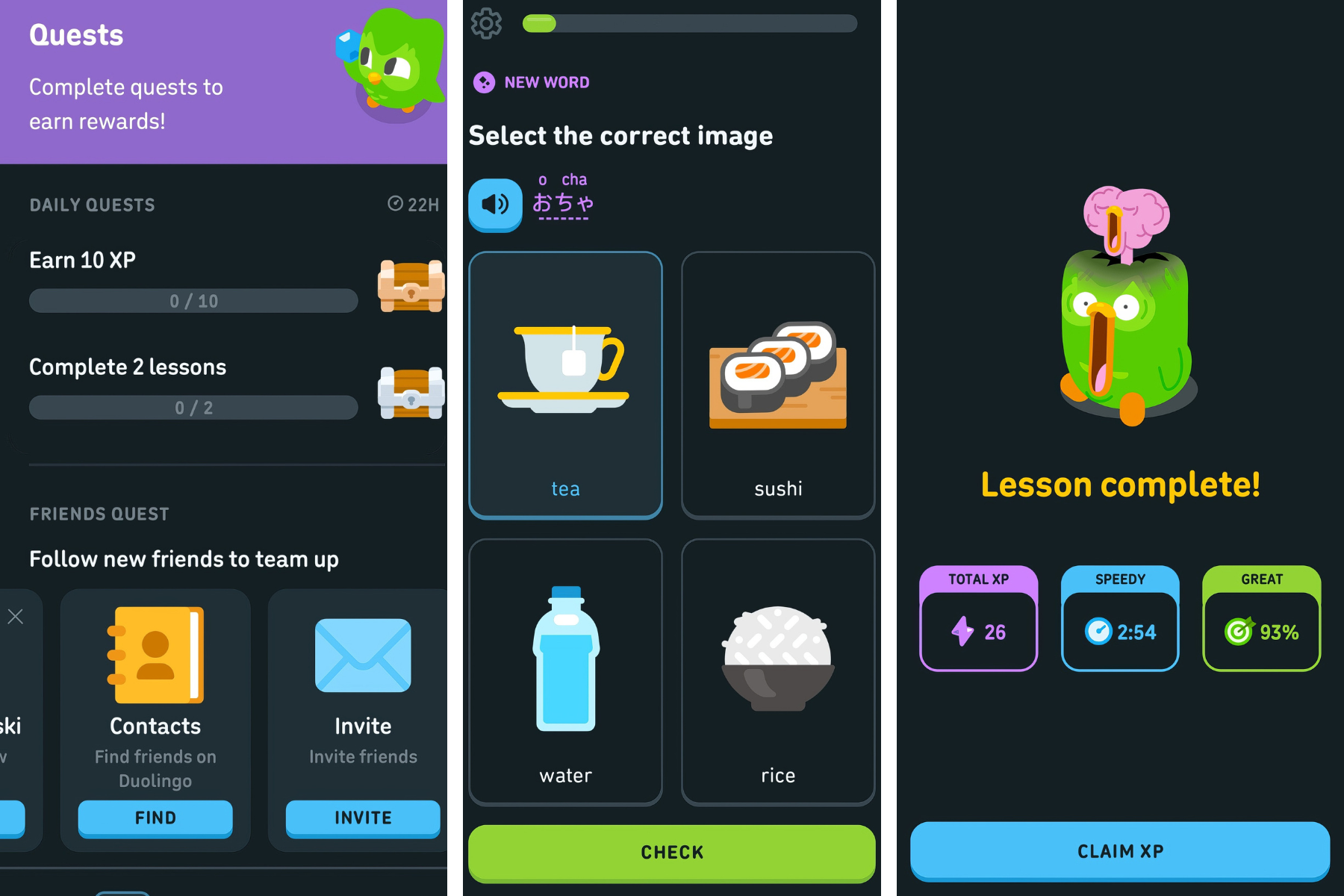
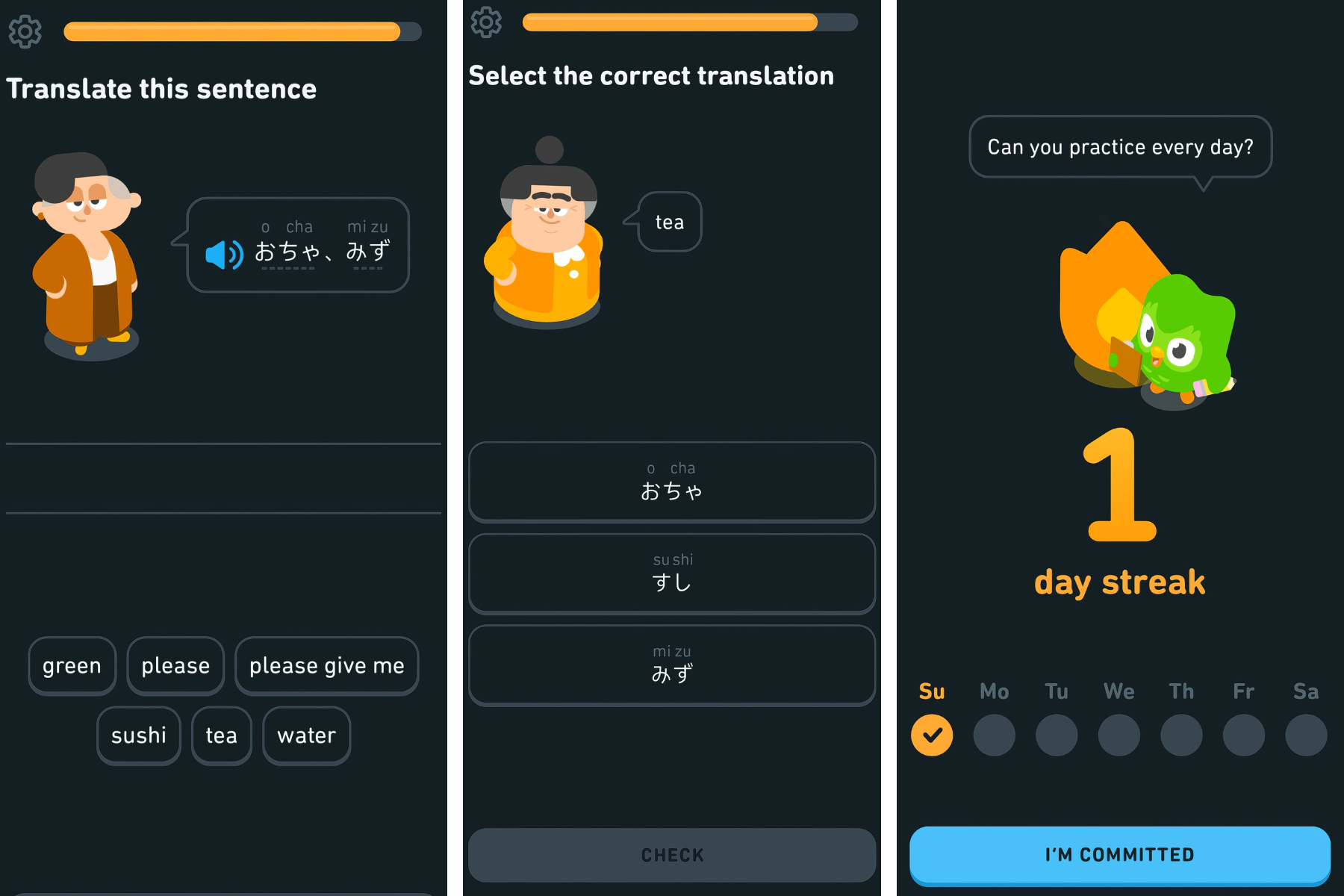
Duolingo repeats the lesson’s words in many different ways. In this example, Duolingo gives you the word and makes you match it with the correct picture or translate a sentence containing the target word.
However, there are limits. Duolingo provides limited grammar explanations and often relies on repetitive, sometimes unnatural phrasing. Users also have a hard time moving from basic vocabulary to real conversations, and they often can't get past level B1. Many language learning apps share this limitation, but it is especially noticeable with Duolingo because the app attracts millions of users who expect it to take them further. Still, as a free app for learning the basics, it is hard to beat.
Babbel: Best for Structured Learning and Grammar
Pros: Excellent grammar explanations, logically structured lessons and real-life dialogues.
Cons: No free tier, sometimes feels like a traditional classroom and offers a smaller number of languages (14 at the moment).
Pricing: Subscriptions range from ~$8.95 to $17.95/month, or a lifetime option for $299.
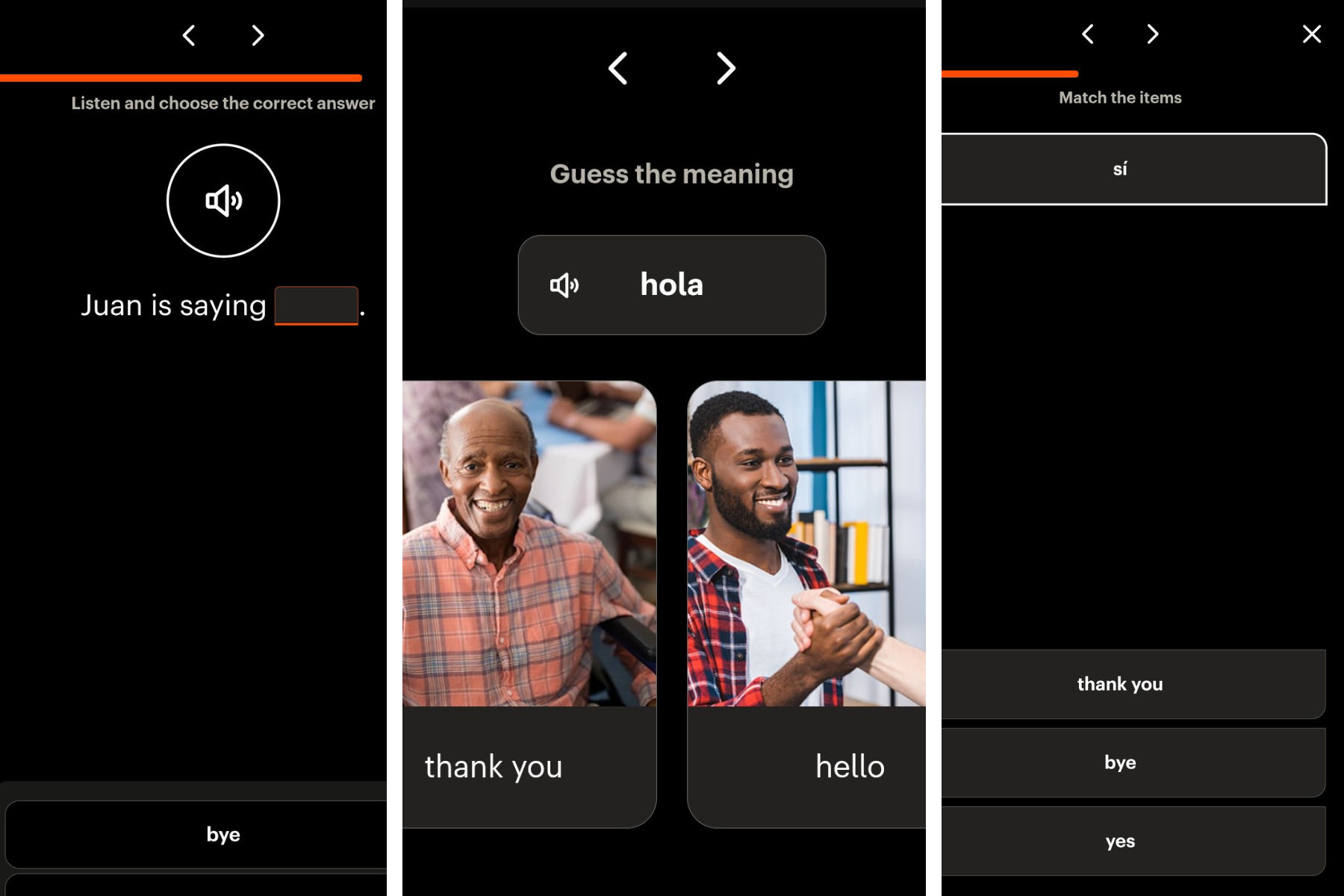
Similar to Duolingo, Babbel makes you repeat the same words in many different ways.
Designed by linguists, Babbel teaches vocabulary in a detailed, structured way that progresses naturally from the basics to advanced using real-world conversations. The learning process feels intuitive, and users practice dialogues they might actually encounter while traveling, making this an effective language course that creates a rich learning experience for anyone studying a language for travel. Babbel is great for serious users who prefer a traditional, classroom-like environment and want a deep understanding of sentence structure. Unlike the other apps on this list that prioritize gamification, Babbel focuses on building genuine language knowledge through structured content.
On the downside, Babbel lacks a complimentary tier; users only get a brief free trial before needing to pay. The structured nature can feel too traditional and rigid for some, and it currently offers only 14 languages. However, if your target language is among them, Babbel offers the best value for those who want clear instruction.
Pimsleur: Best for Audio-Based Learning
Pros: Unmatched for hands-free practice, improves pronunciation and builds early speaking confidence.
Cons: Expensive, requires close attention during 30-minute lessons and lacks comprehensive reading/writing practice.
Pricing: Audio-only starts at $14.95/month; All-Access is $20.95/month.
If you learn best by listening, Pimsleur is the way to go. Most apps aren't great at teaching through audio, but Pimsleur is built entirely around 30-minute audio-based lessons. Since you don't need to look at a screen, it's perfect for hands-free use while you jog, walk the dog or fold laundry. It forces you to speak out loud from day one, which is fantastic for improving your pronunciation and building your confidence. For anyone who wants to learn another language during their daily commute, an app like Pimsleur is the best fit.
Pimsleur forces you to speak out loud from day one, which is fantastic for improving your pronunciation and building your confidence.
The drawbacks are that Pimsleur is expensive compared to other apps and requires close attention during its 30-minute sessions, which isn't ideal if you have only 10-15 minutes to spare. Furthermore, it lacks comprehensive reading and writing practice, focusing almost entirely on verbal skills. If you want to master a language primarily through listening and speaking exercises, however, Pimsleur remains unmatched among language programs available today.
Rosetta Stone: Best for Visual Learners
Pros: Highly novel and exciting immersion method (no translation) and features excellent TruAccent speech recognition.
Cons: Can become repetitive, lacks explicit rule explanations and progress can feel slow.
Pricing: Subscriptions run around ~$11.99 to $15.95/month, or you can purchase a lifetime subscription for $199 to $299.
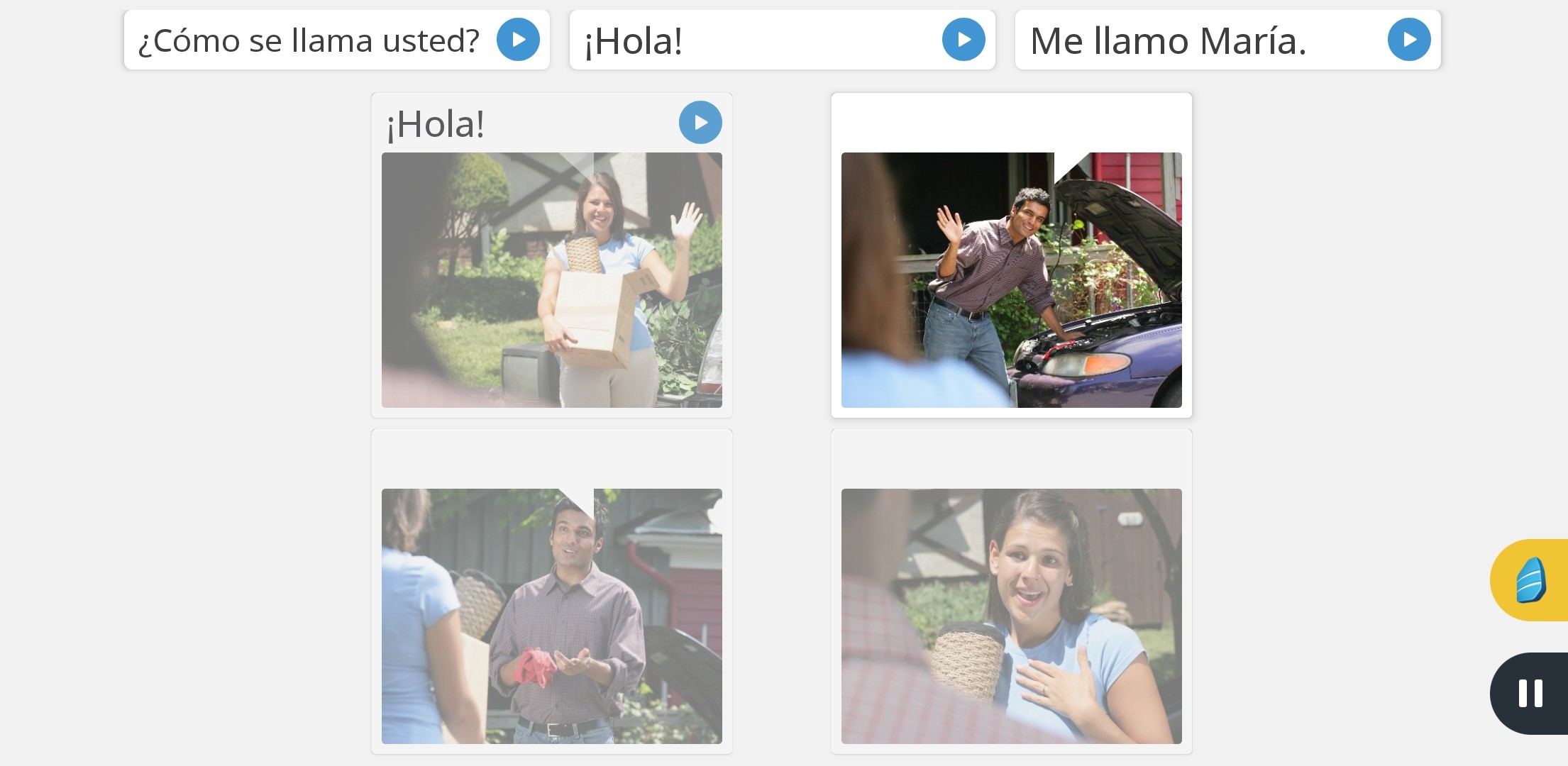
Rosetta Stone is among the best language learning apps for visual users. It relies on its famous "Dynamic Immersion" approach. Instead of giving you direct translations, it shows you pictures and makes you figure out what the words mean based on context. The goal is to train your brain to actually think in the language, similar to how you picked up your native language as a kid. It also has a really good voice recognition tool that listens to you speak and helps you fix your accent so you sound more like a native speaker.
You can choose specific topics that are relevant to you. Rosetta Stone offers non-linear learning, which is maybe a more natural way to learn a language.
The catch: because there is no English, it doesn't hand you the grammar rules. This can get frustrating when you are trying to figure out why a sentence is put together a certain way. Also, clicking through picture-matching exercises over and over again can get pretty boring after a while. Compared to other apps, the process can feel slow, though this deliberate pace is designed to help you internalize the language you are learning at a deeper level.
Talkpal: Best AI Language Learning App for Speaking
Pros: Immersive real-time AI conversations, instant corrections and supports over 57 languages.
Cons: Voices can occasionally sound robotic and pronunciation feedback can sometimes be inconsistent.
Pricing: Free basic tier (limited to 10 minutes of daily time); Premium subscriptions are around $6.00 to $9.99/month.
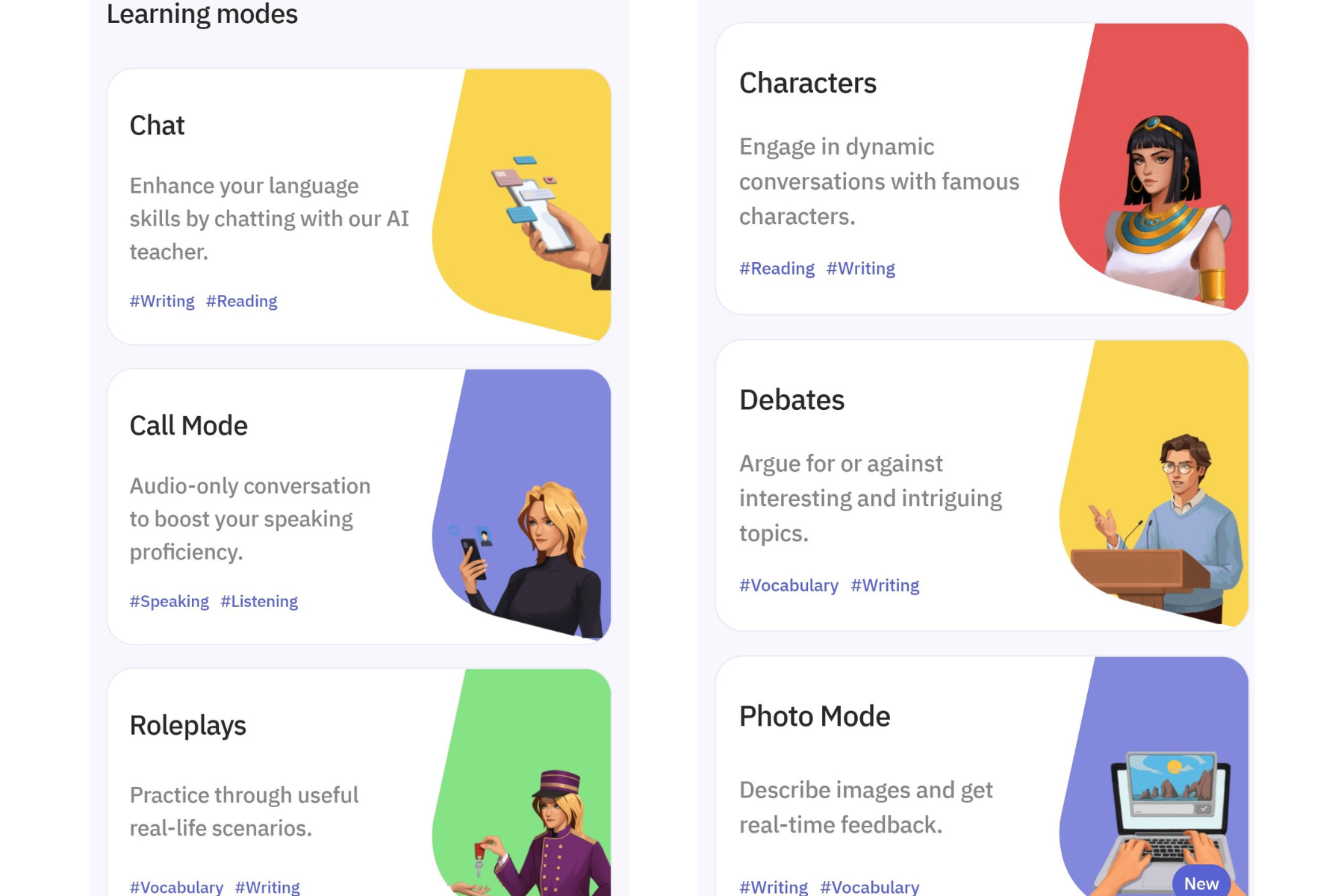
Some of the available learning modes on Talkpal.
Talkpal uses advanced AI to simulate real-life conversations. It talks, role-plays, debates—making it ideal for breaking past the intermediate level to achieve greater fluency. This app offers support for over 57 languages and allows you to chat freely about any topic. As you speak, the AI tutor provides instant, real-time corrections and suggests better phrasing, giving you a low-pressure environment to practice your verbal skills out loud. This AI conversation tool is one of the best apps to learn speaking confidence, especially for those who are nervous about making mistakes in front of a human audience.
However, Talkpal is not ideal for accent training, as its pronunciation feedback can sometimes be inconsistent or accept errors. Additionally, while the technology is powerful, the voices can occasionally sound somewhat robotic compared to human speech. If you want to master a new language through speaking, Talkpal is an excellent learning tool—just pair it with a real tutor when you are ready to use the language in authentic settings.
Memrise: Best for Authentic Vocabulary
Pros: Features thousands of video clips of everyday locals, uses smart memory techniques to help new words stick and focuses on highly practical vocabulary.
Cons: Limited instruction on sentence structure and content becomes shallow at advanced levels.
Pricing: Free limited version; Pro plans are ~$8.49 to $8.99/month or $59.99/year.
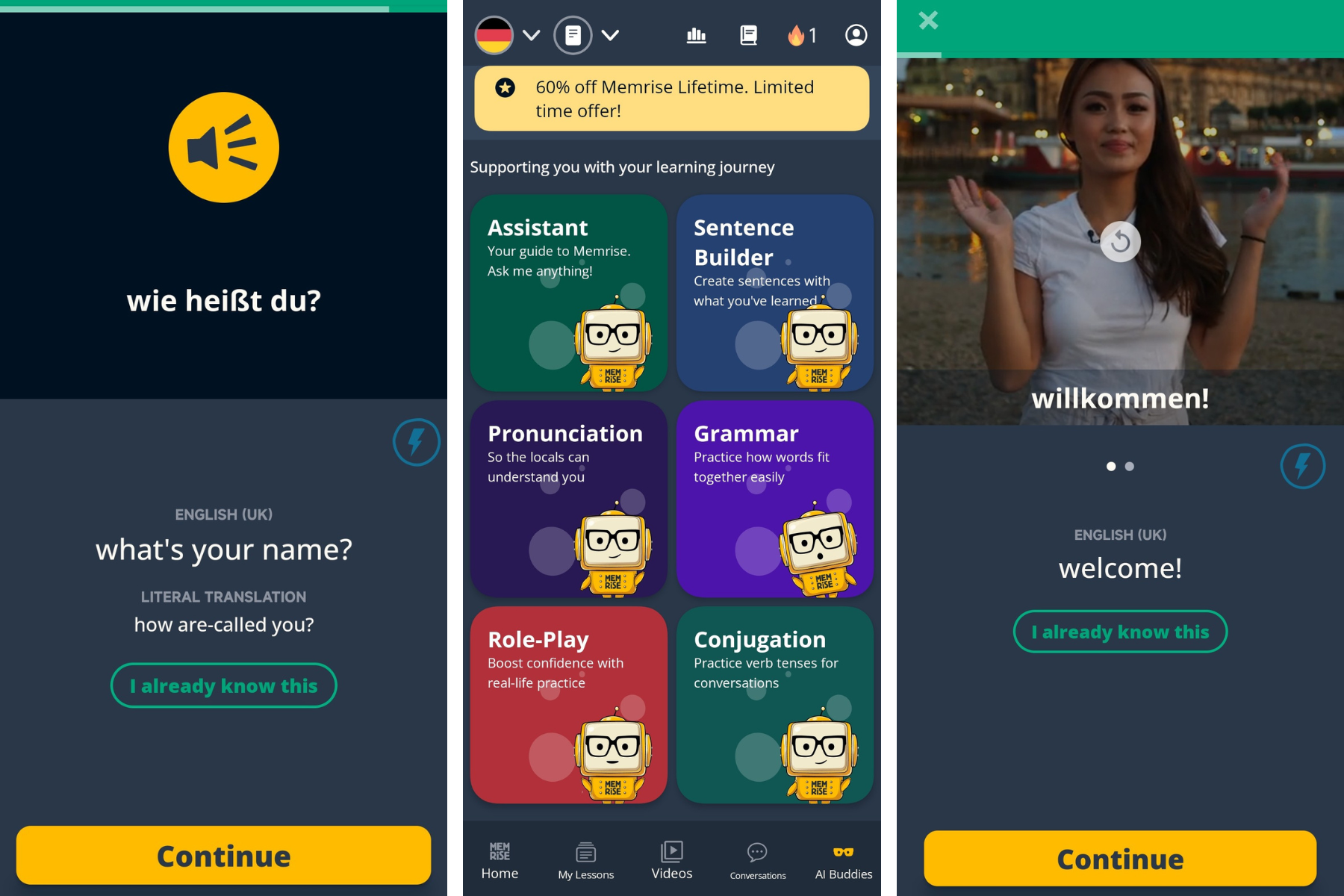
Memrise focuses on authentic word acquisition. It shows users thousands of short video clips of real locals speaking in their natural accents and real-world contexts. This helps connect sounds directly to real human faces, body language and cultural context. To make sure these new phrases actually stick, the app uses a smart memory system. This system tracks when you review words and tests you on them just before you forget them. This is a proven system for locking practical, everyday vocabulary into your long-term memory. For those who want to learn languages by hearing native speakers use them in the real world, Memrise is hard to beat.
Memrise uses a smart memory system to help you review words just before you forget them. You also get literal translation, which deepens the learning.
The main drawback to Memrise is that it provides very limited explanations of rules and structure. It focuses heavily on vocabulary and individual phrases, not on sentence construction. The content often becomes shallow at advanced levels. It functions as a supplementary tool alongside a more comprehensive app.
Busuu: Best for Community Feedback
Pros: Features a structured CEFR-aligned curriculum and allows users to receive writing and speaking corrections directly from a community of native speakers.
Cons: Full access is paywalled and community feedback quality can vary depending on the user correcting you.
Pricing: Free basic version; Premium plans range from ~$6.86 to $12.99/month.
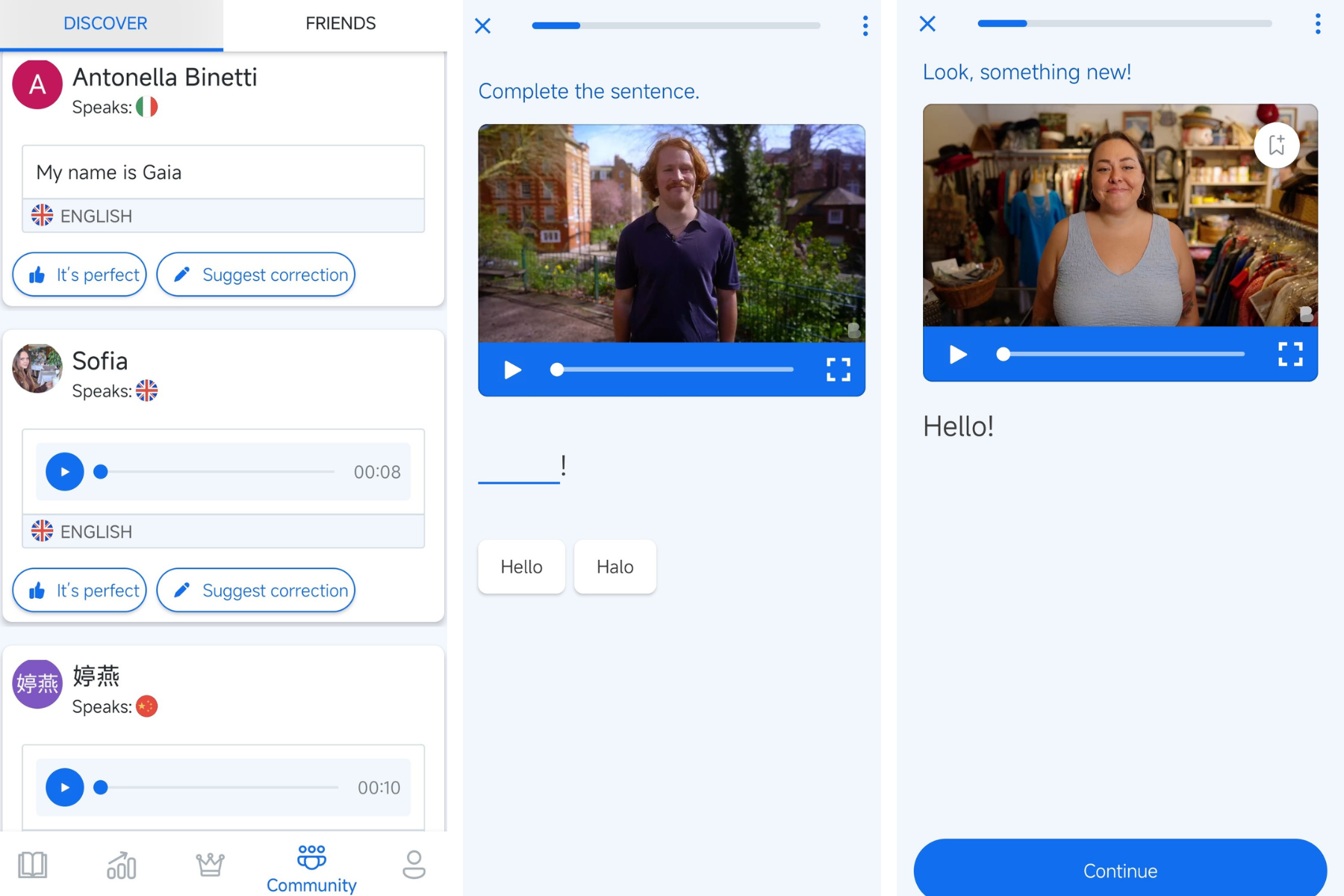
Similar to Memrise, Busuu has video clips of natives, provided by the community. The community helps by giving and receiving feedback.
Busuu combines structured courses with a unique peer-to-peer social component, bridging the gap between theoretical knowledge and practical application. The curriculum is designed around the Common European Framework of Reference for Languages (CEFR), so that users can follow a clear, logical path from beginner to upper-intermediate levels. What truly sets Busuu apart, however, is its interactive community feature. As you progress through the coursework, you can submit your speaking and writing exercises to a global community of native speakers who provide real-time corrections, cultural context and feedback. This built-in language exchange lets you help others learning your native language while they help you improve in the language you're studying.
While this community aspect is a massive advantage, it does come with a caveat. Because feedback comes from everyday users rather than professional language tutors, the quality and accuracy of the corrections can sometimes vary depending on who is helping you. Additionally, while there is a basic version available at no charge, full access to the most valuable tools and advanced lessons is paywalled behind a premium subscription. Busuu is a strong choice for those who thrive on human connection—something apps like Duolingo lack.
Drops: Best for Visual Vocabulary
Pros: Features a beautiful minimalist UI, fast-paced games and a vast library of 50+ languages.
Cons: Focuses on vocabulary with no explicit sentence structure or construction practice.
Pricing: Free basic version (limited to 5 minutes daily); Premium subscriptions run around $9.99 to $12.99/month, or you can buy a lifetime plan for $159.99.
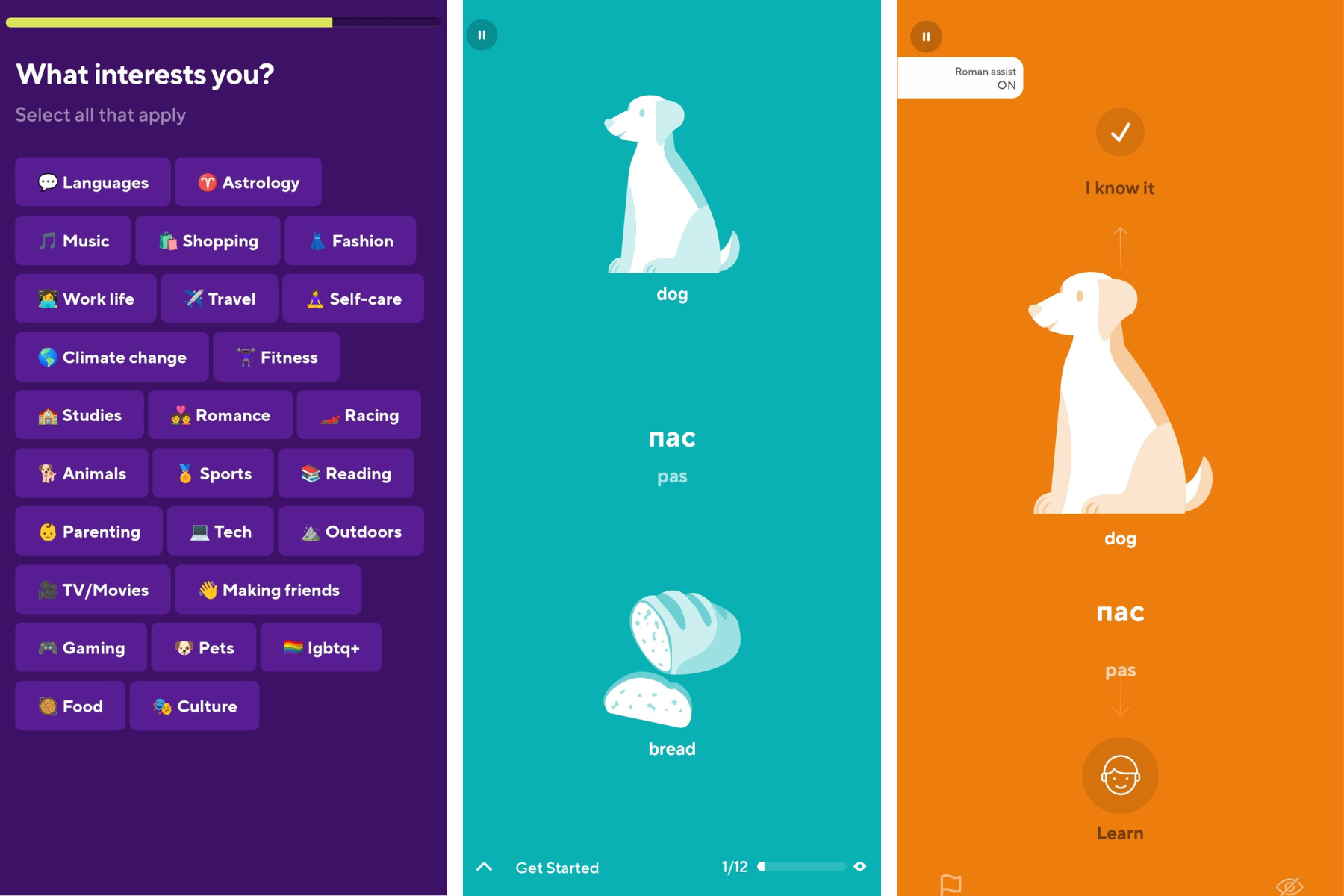
Every word has a corresponding picture. Lessons focus on speed, not complexity.
Drops transforms traditional vocabulary memorization into a visually engaging, fast-paced matching game. It's perfect for users with busy schedules who want to expand their lexicon in short bursts. The app relies on a beautiful, minimalist UI and illustration-based exercises to help build strong mental associations between fresh terms and images, bypassing the need for translation. Drops has a vast library of over 50 languages, including many less commonly taught options (see the full list here). It is an excellent tool for acquiring vocabulary across a wide variety of topics, and if you want to tackle a single language quickly, its focused approach can yield rapid results.
However, Drops is highly specialized and strictly focuses on word acquisition. It provides no instruction on rules or sentence construction practice. It functions as a supplementary resource rather than a comprehensive, standalone language course. Furthermore, the free version restricts users to just five minutes of practice per day. While this creates a sense of urgency that builds a daily habit, serious users will likely need to upgrade to remove the time limit. You can also try the app for free during an initial trial period to see if its visual style matches your preferences.
Rosetta Stone vs Drops – similar, yet different
While both rely on visual methods and avoid English translations, their scope and pacing are different. Rosetta Stone is a slow, comprehensive curriculum designed to teach full sentences and grammar using its Dynamic Immersion method. It demands focus and time to build foundational intuition. In contrast, Drops is a fast-paced, gamified supplement built for rapid-fire word memorization. Drops intentionally omits structural instruction, making its five-minute micro-sessions perfect for quick daily practice. It's not great as a standalone program, but when paired with different apps that cover grammar, the combination can be powerful.
Langua: Best for Regional Dialects and Natural Voices
Pros: Incredibly human-sounding AI voices, highly specific feedback reports and integrates flashcards.
Cons: Relatively expensive and its interface is more functional than visually gamified.
Pricing: Standard plan is $19.99/month; Unlimited plan is $29.99/month.
Langua acts as an elite AI coach for spoken practice. It allows you to hold hands-free conversations with AI models with cloned native-speaker voices. What makes Langua stand out is its emphasis on genuine regional dialects and human-sounding interactions. There's no robotic text-to-speech here. You can role-play specific scenarios, debate or just chat casually about the local language and culture. Following a conversation, the app provides written and audio feedback reports, including cultural tips and grammar explanations. It also allows you to save new words into an integrated flashcard system to deepen your language knowledge over time.
While it is a powerful tool for building speaking confidence without the pressure of a human audience, it does have some drawbacks. Its interface is highly functional but lacks the engaging, visual gamification found in competitors. Because it focuses on open-ended spoken exchanges, absolute beginners might feel it lacks a rigid, guided curriculum. Finally, it is a relatively expensive investment compared to basic options. If you are an intermediate or advanced language learner who wants to practice speaking in the language you want to learn, Langua delivers a remarkably authentic experience.
Preply: Best for 1-on-1 Tutoring
Pros: Direct access to real native speakers, personalized lessons and immense flexibility.
Cons: Requires a scheduling commitment and can become expensive over time compared to self-paced apps.
Pricing: Pay-per-lesson model, with prices varying widely by tutor (starting around $5 to $10/hour).
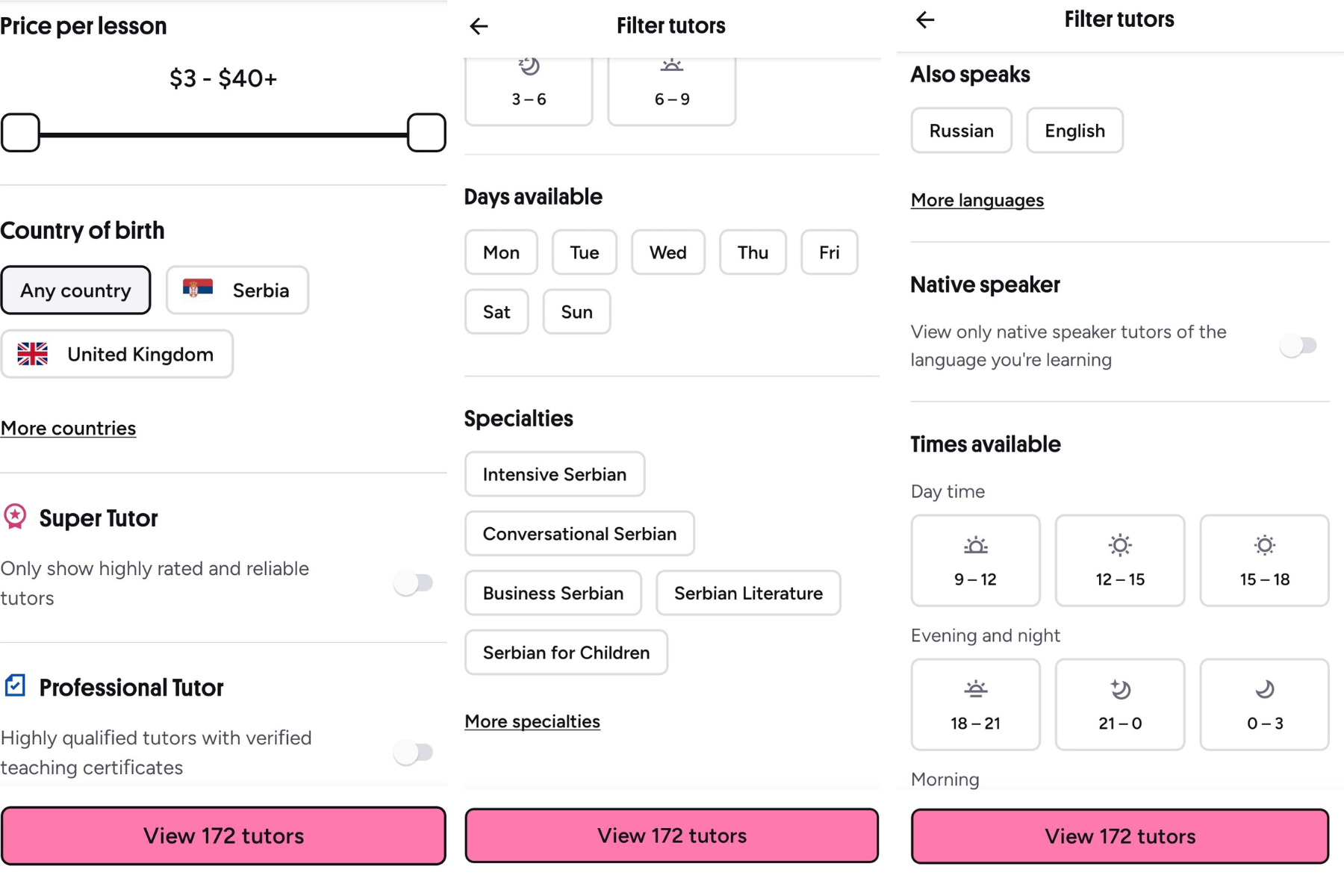
Preply has a lot of filters you can use to find the perfect tutor for you.
Some users recognize that software alone is not enough to achieve true fluency. Preply bridges the gap by connecting users globally with thousands of human tutors. It allows you to find an instructor whose teaching style, schedule and price match your needs for live conversation practice. You can browse tutor profiles, watch introduction videos and take trial lessons until you find the perfect match. For those ready to learn the language through real conversation, Preply is the natural next step after mastering the basics on a self-paced app.
Working with a human tutor provides the ideal environment for real-world application. You get immediate pronunciation corrections, grammar explanations and cultural context. A second language truly comes alive when you can practice speaking with a real person who can adjust to your level in real time.
Working with a human tutor provides the ideal environment for real-world application. You get immediate pronunciation corrections, grammar explanations and cultural context.
The primary drawback is that, unlike AI tools available 24/7, Preply requires you to schedule sessions in advance. Also, taking multiple live lessons a week can represent a larger financial investment over time. Still, for effective language practice at the upper-intermediate to advanced level, one-on-one tutoring remains the gold standard.
Frequently Asked Questions (FAQ)
Apps can be a great help with building vocabulary, grammar skills and basic speaking confidence, but they can't make you fully fluent on their own. True fluency requires understanding native speakers in spontaneous, real-world conversations and grasping cultural differences. For ideal results, pair your app with live classes. The best language learning apps depend on real practice to supplement what they teach, so start learning with an app and then graduate to human interaction when you're ready.
Most apps can realistically take you to an intermediate level, which is B1 on the CEFR scale. They are excellent for mastering A1 to A2 beginner basics, but reaching advanced levels, from B2 to C2, requires a human teacher. No matter which foreign language you are studying, the progression from intermediate to advanced is where live tutoring makes the biggest difference.
Premium subscriptions usually cost between $5 and $20 per month, which is often less than a single live tutoring session. Upgrading unlocks essential tools like unlimited daily access, offline use and advanced AI features, making them highly cost-effective for building a consistent habit. Also, keep in mind that even though live classes are pricey, they are still irreplaceable. (Maybe one day, but the current technology isn't there yet.) For a beginner who just wants to get started without a large upfront cost, the ideal choice is often one that lets you try it for free and then upgrade when you're committed.
Progressing from a total beginner (A1) to a conversational level (B1) generally takes between 300 and 600 hours of study. Most apps suggest practicing 15 to 30 minutes daily. Ultimately, showing up to practice consistently matters much more than trying to rush. If you are trying to pick up a new language, remember that every minute of daily practice compounds into real progress over time.
Apps provide great flexibility and convenience for busy schedules. However, traditional classes and live tutors offer personalized feedback, immediate real-time corrections and the crucial human interaction that automated software lacks. If you're learning with an app alone, consider adding a live session once a week to accelerate your progress and start to use the language in real settings.
To App or Not to App: Start Your Language Journey
The one of the best language tips we can give you is this: match the tool to how you absorb information. Visual types tend to do well with Drops or Rosetta Stone. If you respond better to audio, Pimsleur is hard to beat. Need solid grammar? Go with Babbel. Want to practice speaking? Try Talkpal or Langua.
The one of the best language tips we can give you is this: match the tool to how you absorb information.
You don't have to pick just one. A simple combination like Duolingo for daily habit-building and Talkpal for speaking practice can go a long way. Many users find that mixing different apps keeps the experience fresh and covers more ground than any single option can on its own. If you are not sure where to begin, remember that users learning the same language often benefit from browsing community forums to see which tools others recommend.
Just keep in mind that apps work best as a starting point, not a finish line. At some stage, real conversations with real people will move you forward faster than any app can. When you get there, Scolingo's live classes are a natural next step.
Petar's career began with formal training in music as a classical violist, then shifted toward the cognitive sciences, earning a Master's degree in psychology. After working as a school psychologist and youth care worker, he applied his expertise in human engagement to game design as a full-stack developer. Today, he is a content writer on the Scolingo team and about to take the final exam for the state school psychologist license.