Words, History & Linguistics
#Hawaiian
The Hawaiian Alphabet: Why It Has Only 13 Letters (and Rotokas Has Even Fewer)
SF
Scolingo Founder
7 min read
·
113 views
Published:
October 15, 2026
Updated:
October 22, 2026
Alphabet size is not a measure of how simple a language is. It is a measure of how many sounds a writing system decided to keep apart.
In 1826, the people shaping the Hawaiian alphabet held a vote. The alphabet was only four years old, and the vote was about deleting letters.
The reason is easy to see in a single word. Before the vote, the Hawaiian word for prayer could be written pule, bule, pure or bure, because the Hawaiian ear treated p and b as one sound, and l and r as one sound. Four spellings, one word. After the vote, there was only pule.
That small act of deleting letters is why Hawaiian is now written with 13 of them, and it says something about what an alphabet is actually for.
Quick answer: The Hawaiian alphabet has 13 letters: five vowels (a, e, i, o, u) and eight consonants (h, k, l, m, n, p, w and the ʻokina). You may also see 12, which is the count without the ʻokina.
What the vote removed
The first printing, in January 1822, used more letters than Hawaiian needed. In 1826 the developers voted to drop the ones that were interchangeable with another letter:
• B and P were interchangeable. P stayed.
• L, R and D were interchangeable. L stayed.
• K and T were interchangeable. K stayed.
• V and W were interchangeable. W stayed.
The goal, as historians of the alphabet describe it, was to get close to one symbol for one sound, so that reading and writing would be quick to teach and learn.
The 13 letters, and how to say them
Hawaiian lists its vowels first. Five vowels and eight consonants make up the alphabet, and the eighth consonant is not a letter you will find on an English keyboard.
| Letter | Say it like | Good to know |
|---|---|---|
| a | ah | Always the same vowel, never “ay” as in English cake |
| e | eh | As in bet |
| i | ee | As in see |
| o | oh | A clean “oh” |
| u | oo | As in moon |
| h, k, l, m, n, p | close to English | Hawaiian has only these six regular consonants besides w and the ʻokina |
| w | w or v | Tends to sound like v after i and e, and like w after u and o |
| ʻ (ʻokina) | the catch in “uh-oh” | A real consonant: a brief stop in the throat |
Two marks do extra work. The ʻokina is the glottal stop, the little catch in the middle of “uh-oh.” It is why the state name is written Hawaiʻi, and said roughly “ha-VY-ee” with a catch before the last vowel. The kahakō is a bar over a vowel (ā, ē, ī, ō, ū) that makes it long. It is not counted as a separate letter.
These marks are not decoration. In the Hawaiian Bible, the missionaries used the apostrophe to tell koʻu (my) apart from kou (your). One tiny mark, two different words. The ʻokina only became a recognized letter of the alphabet in 1864, when William DeWitt Alexander published a grammar that treated the glottal stop as a true consonant.
These marks are not decoration. In the Hawaiian Bible, the missionaries used the apostrophe to tell koʻu (my) apart from kou (your). One tiny mark, two different words. The ʻokina only became a recognized letter of the alphabet in 1864, when William DeWitt Alexander published a grammar that treated the glottal stop as a true consonant.
Why Brazil became Palakila
Here is the part that makes the small alphabet feel like a rule instead of a limit. Hawaiian syllables are built from an optional consonant plus a vowel, and every consonant must be followed by a vowel. Words end only in vowels.
Now give Hawaiian a foreign word. Brazil has a B, an R, a Z and a final L, and Hawaiian has no good place for any of that. So B becomes P, R and Z become L, and vowels are added to keep the pattern. Brazil becomes Palakila. Gibraltar became Kipalaleka. The same machine turns “Christmas” into Kalikimaka, which is why “Merry Christmas” is Mele Kalikimaka.
Try saying Palakila aloud. Five tidy syllables, nothing a Hawaiian speaker would trip on.
Rotokas: 12 letters for 11 sounds
Hawaiian is not even the smallest. Rotokas, spoken on the island of Bougainville in Papua New Guinea, is widely described as having the smallest alphabet in use today: 12 letters.
They are A E G I K O P R S T U V. That is six consonants and five vowels, so 11 sounds, and the twelfth letter exists for a practical reason: the sound /t/ is written S before an I, and T everywhere else.
Rotokas spelling also makes its letters stretch. The letter R can stand for a d, a quick tapped r or an l. G can be a hard g or a softer, rubbed one. And like Hawaiian, Rotokas separates long vowels from short ones. It does it by doubling the letter, so aa, ee and oo are long.
So both languages do the same thing in different ways. A small inventory of sounds gets a small alphabet, and the details of length and catches are handled by a mark or a doubled letter.
What alphabet size really measures
Put the numbers side by side and the pattern is clear. Hawaiian and Rotokas sit far below every other alphabet in the chart. But a short alphabet only tells you how many distinct sounds a writing system chose to keep apart. It tells you nothing about how hard the language is.
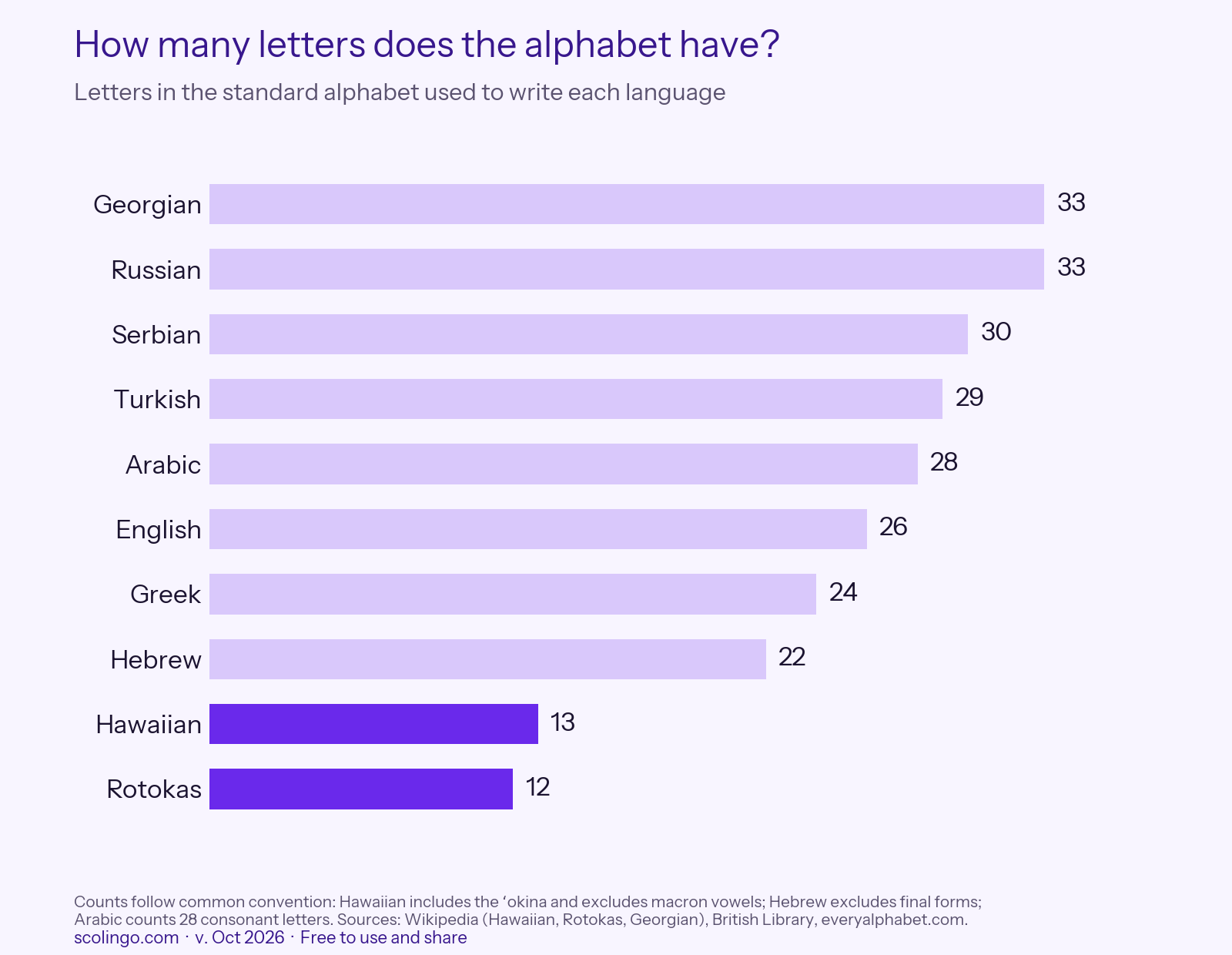
Georgian shows the same logic from the other direction. It once had 38 letters. Five were dropped after reforms proposed in the 1860s, and the modern alphabet has 33, with each letter read as one sound. Serbian pushed the idea further. Vuk Karadžić’s nineteenth-century reform followed the rule of writing as you speak and reading as it is written, and left Serbian with 30 letters in each of its two scripts. The full chart is in our Serbian alphabet guide.
English keeps a 26-letter alphabet and then needs pairs like sh, th and ch to cover the sounds it has no letter for. It is not worse for it. It just shows that every alphabet is a compromise between the number of letters and the number of rules.
English keeps a 26-letter alphabet and then needs pairs like sh, th and ch to cover the sounds it has no letter for. It is not worse for it. It just shows that every alphabet is a compromise between the number of letters and the number of rules.
A spelling that made reading fast
Hawaiian’s spelling turned out to be easy to master. The orthography was so straightforward that literacy spread quickly among adults, and in an 1853 report the minister of public instruction, Richard Armstrong, claimed that about 75 percent of the adult population could read. That is his claim, not an independently verified figure.
The story took a hard turn after the overthrow of the Hawaiian monarchy. Act 57 of the 1896 laws of the Republic of Hawaii made English the medium of instruction in schools, and Hawaiian children were punished for speaking their language at school. Hawaiian-medium instruction in public schools did not return until 1987. In 1984, the ʻAha Pūnana Leo opened its first Hawaiian-language preschool, and immersion schools followed. UNESCO still classes Hawaiian as critically endangered.
Thirteen letters, two marks, and a spelling system built so that what you see is very close to what you say.
Quiz: do you know your small alphabets?
Answers are below the questions. No peeking.
1. Before the 1826 vote, which of these could all be spellings of the same Hawaiian word?
A) pule, bule, pure, bure
B) pule, puli, pulu, pula
C) pule, pele, pile, pale
2. What does the ʻokina represent?
A) a long vowel
B) a glottal stop
C) a silent letter
3. How many letters does the Rotokas alphabet have?
A) 7
B) 12
C) 19
4. What does Hawaiian make of the word “Brazil”?
A) Barazila the only way
B) Brasi
C) Palakila
5. Which letter is Hawaiian’s eighth consonant?
A) the ʻokina
B) the macron
C) the letter z
Answers
1. A. The B/P and L/R pairs were interchangeable, so one word could be spelled four ways. The vote kept pule.
2. B. It is the glottal stop, the catch in “uh-oh.” The kahakō marks long vowels.
3. B. Twelve letters for eleven sounds, because S and T both write /t/.
4. C. Palakila. B becomes P, R and Z become L, and vowels are added to fit the Hawaiian pattern.
5. A. The ʻokina counts as a consonant. The macron is a mark, not a letter.
Scoring:
5 correct, you could teach this.
3 or 4, you now know more about Hawaiian spelling than most people.
0 to 2, read it again and send it to someone who will enjoy being surprised.

Scolingo Authors
Scolingo authors are experienced language teachers, linguists, psychologists, and pedagogical specialists with years of experience in schools, universities, and online education. With advanced degrees and expertise across multiple languages, many are also published authors and educational materials creators, combining academic knowledge with practical teaching experience.
← Back to Blog
7 min read