Sanskrit and Serbian Similarities: Shared Words, Sounds and Grammar
SF
Scolingo Founder
8 min read
·
43 views
Published:
November 12, 2026
Updated:
November 19, 2026
Serbian and Sanskrit are distant relatives, not parent and child. See the verified word pairs, the sound changes and grammar they share, why the "Serbs came from India" claim fails, and the Indian-origin language spoken in Serbia today.
Are there real Sanskrit and Serbian similarities? Yes, and they are better explained than most claims online. Serbian is not descended from Sanskrit. The two are distant relatives: both come from Proto-Indo-European, the reconstructed ancestor of most European languages and many South Asian ones. The links show up in number words, family words, a sound change called satem, and parts of the grammar. This guide shows the word pairs we could verify, the sound rules behind them, the grammar they share, the myths to ignore, and the Indian-origin language that is actually spoken in Serbia.
Are Sanskrit and Serbian related?
Yes, as cousins. Sanskrit belongs to the Indo-Aryan branch of the Indo-European family. Serbian is a South Slavic language, and Slavic is another branch of the same family. Wikipedia's article on Sanskrit says it arose from a common root language, Proto-Indo-European, and that shared words such as "mother" and "father" suggest this common origin. It does not present Sanskrit as an ancestor of European languages, and neither does any source we found.
The oldest Sanskrit text is the Rigveda, composed between 1500 and 1200 BCE according to the same article. Sanskrit is one of the three earliest documented languages descended from Proto-Indo-European. That age is why it is so useful for comparison: it kept old features that later languages lost. It is a relative that was written down early, not a parent.
Serbian and Sanskrit are related as cousins, not as parent and child: both descend from Proto-Indo-European.
The sources for this guide are Wikipedia articles and a Council of Europe fact sheet. We read them on 8 November 2026 and did not have access to the underlying academic papers, so treat the word lists as a reliable summary of standard etymology, not as original research.
Which Sanskrit and Serbian words are the same?
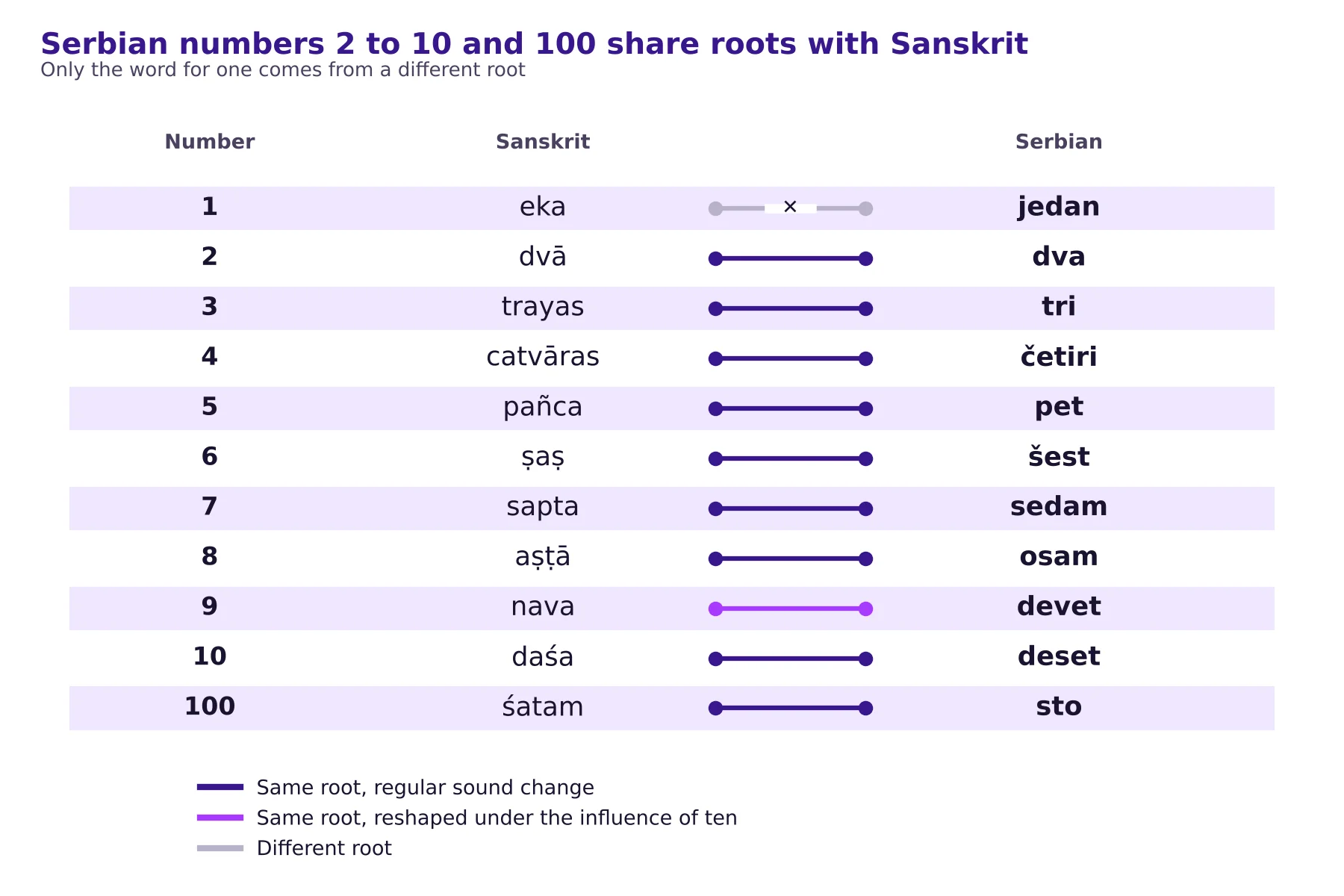
The clearest match is the numbers. Wikipedia's table of Proto-Indo-European numerals gives Sanskrit and Old Church Slavonic forms side by side. Old Church Slavonic is the oldest recorded Slavic language, and the Serbian number words are its modern descendants. For 2 to 8, 10 and 100 the table calls the pairs regular cognates, meaning words that go back to the same ancestor word by regular sound change. Nine has the same root, but the Slavic form was reshaped under the influence of the word for ten. One is the exception: the Sanskrit and Slavic words come from different formations.
Beyond numbers, the same table of shared vocabulary on Wikipedia lists family words, body parts and nature words. The Sanskrit and Old Church Slavonic forms below come from that table, and the Serbian words are their modern descendants.
listed as related, with different vowels and start
fire
agní
oganj
a became o
smoke
dhūmá
dim
dh became d and ū became i
name
nāman
ime
Serbian has no n- at the start
new
náva
nov
a became o
Reading down the last column, you can see a few regular patterns: Sanskrit a often matches Serbian o, bh and dh lose their breath and become b and d, and ū becomes i. These are our observations from the table, but they are the kind of regular correspondences linguists use to prove two words are related and not just similar.
Two cautions. First, some pairs look alike but are not related, and some related pairs look different. In the same Wikipedia table, the Sanskrit word for "tooth" and the Old Church Slavonic word are listed under different roots. Second, meaning can shift. A root reconstructed as *weyd- shows the shift: Sanskrit vetti means "knows", while the Slavic verb behind Serbian videti means "to see". Same root, different meaning.
What sound changes connect Sanskrit and Serbian?
Two sound changes tie the Slavic and Indo-Iranian branches together, and Sanskrit is in the Indo-Iranian one.
The first is the satem change. Proto-Indo-European had a series of k-like sounds that turned into hissing sounds in some branches and into plain k in others. The word for "hundred" shows it: Sanskrit śatam and Serbian sto begin with a hissing sound, while Latin centum begins with k. Wikipedia lists Indo-Iranian and Balto-Slavic as the main satem branches. It also says it is no longer thought that the family split first into a centum half and a satem half. The split is now seen as an early area-wide phenomenon, not a true family tree division, and Tocharian, the most eastern branch, is a centum language.
The second is the ruki rule, named after the sounds r, u, k and i. A 2024 post on Arnold Zwicky's linguistics blog describes it as the change of s to a different sound after those four. In Sanskrit the s becomes a retroflex ṣ in that position. The article says Holger Pedersen showed in 1895 that Proto-Slavic s changed to x, via š, in the same environment, and that Old Iranian shows the same pattern as Sanskrit. Whether and how far Baltic took part is debated. Wikipedia's article on centum and satem languages cites the ruki law as independent evidence that the ancestors of these branches were in close contact.
Do Sanskrit and Serbian share grammar?
In structure, yes, but in different amounts. Both have noun cases, three genders and a past tense system with the aorist and the imperfect, but Serbian has simplified several of them.
aorist and imperfect marked and rather archaic, though the aorist can even be the most common past tense in some parts of Serbia
The Serbian side comes from Wikipedia's article on Serbo-Croatian grammar, and the Sanskrit side from its article on Vedic Sanskrit grammar. The dual is the most striking link. It was a number for exactly two things, and it is a living category in Sanskrit. In Serbian it survives as a trace: the numbers 2, 3 and 4 take the genitive singular, which the article calls a vestige of the dual. The aorist and imperfect are the tenses we found in both descriptions. We did not find a source that traces them to a single origin, so we only say that both languages have them.
We did not compare other features, such as verbal aspect, because we found no verified comparison.
Do Sanskrit and Serbian use the same alphabet?
No. Wikipedia says Sanskrit was originally passed on orally and does not have an attested native script. It was first written in the Brahmi script in the 1st century BCE, and Devanagari is the most common script for Sanskrit today. Serbian is written in Cyrillic and Latin. Different scripts hide the family resemblance, which is why the words above are easier to see in transliteration. For the Serbian letters and how Cyrillic maps to Latin, see The Serbian Cyrillic Alphabet: All 30 Letters and Their Latin Twins.
Is Serbian descended from Sanskrit, and did the Serbs come from India?
No. This is the most common claim online and the one without support. Serbian comes from the Slavic line and Sanskrit from the Indo-Aryan line. The two lines meet only at Proto-Indo-European.
Where does the idea come from? One source is the Srbinda theory. In the Rigveda, Srbinda is a mythical enemy of the god Indra, who is killed in battle, according to Wikipedia's article on the name. In 1934 the German indologist Walther Wüst argued that Srbinda was a leader of the Serbs and that the "floods" in the hymn described a migration. The English Sanskritist Monier Monier-Williams had analysed the name in 1872 as Sanskrit sṛ, "to flow", plus bind, "to break". The article says two later authors, Rudnicki in 1959 and Gluhak in 1993, treat the name as unrelated to the Serbian ethnonym. Wikipedia presents the Srbinda link as a theory held by certain historians, not as an accepted etymology.
Other claims go further, for example that Sanskrit is "old Serbian" or that the term Indo-European should be replaced by "Serbian". We found these asserted in a comment thread, with no sourced linguistic analysis and no support from other participants. Real comparison needs regular sound correspondences, like the ones in the table above, and these claims do not provide them. We also found nothing in the sources we read that supports a migration of Serbs from India.
Is there an Indian language in Serbia today?
Yes, and it is Romani. The Council of Europe describes Romani as the only Indo-Aryan language used exclusively in Europe since the Middle Ages. Wikipedia lists 79,687 Romani first-language speakers in Serbia in 2022, 1.27%. It also lists a separate mixed language, Romano-Serbian, native to Serbia, with 170,000 native speakers as of 2006. These counts come from different surveys and categories, so they cannot be added together.
Romani belongs to the Indo-Aryan branch, the same branch as Sanskrit, and it comes down from the same Indian line. Wikipedia gives these: Sanskrit akṣi and Romani jakh, "eye"; pānīya and pani, "water"; bhūmi and phuv, "earth"; dugdha and thud, "milk"; pṛcchati and pučhel, "to ask". The Romani numbers 2 to 5 are duj, trin, štar and pandž. Set beside Sanskrit dvá, trí, catvā́raḥ and páñca and Serbian dva, tri, četiri and pet, they line up three related languages.
We did not find a verified list of Romani words in Serbian, so we do not give one.
Does knowing Sanskrit help you learn Serbian?
A little, in our judgment, and we found no study that measures it. The shared number words and family words are easy memory hooks. If you have studied Sanskrit, the ideas of cases, three genders and a former dual number will not be new. But the matching vocabulary is a small share of everyday Serbian, and the sounds have shifted enough that most learners will not recognize pairs without being shown. Serbian grammar and vocabulary are learned on their own, with a teacher or a course, not through Sanskrit.
Scolingo authors are experienced language teachers, linguists, psychologists, and pedagogical specialists with years of experience in schools, universities, and online education. With advanced degrees and expertise across multiple languages, many are also published authors and educational materials creators, combining academic knowledge with practical teaching experience.