Serbian Alphabet: A Complete Guide to Cyrillic and Latin Scripts
SF
Scolingo Founder
August 22, 2026
16 min read
·
34 views
Petar Kotevski
Petar's career began with formal training in music as a classical violist, then shifted toward the cognitive sciences, earning a Master's degree in psychology. After working as a school psychologist and youth care worker, he applied his expertise in human engagement to game design as a full-stack developer. Today, he is a content writer on the Scolingo team and about to take the final exam for the state school psychologist license.
Hello and welcome to the Serbian Alphabet! Serbian is a South Slavic language spoken by ~ 12 million people. The Serbian language is one of the few in the world that actively uses two alphabets.
Before we go deeper, here are some facts:
• Both Cyrillic and Latin scripts have exactly 30 letters each.
• Both scripts are entirely interchangeable. Every letter from Cyrillic has a corresponding letter in Latin. A = A, B = Б, C = Ц, and so on.
• Both scripts are 100% phonetic, meaning one sound equals one letter. No exceptions.
This means that there are no silent letters and no spelling irregularities to memorize.
While the Serbian language is considered difficult to learn, Serbian Alphabet is surprisingly easy. It takes a few hours to a few days.
The golden rule of the alphabet was established by the linguist Vuk Karadžić, and it goes like this: "Write as you speak, read as it is written" (Piši kao što govoriš, a čitaj kao što je napisano).
This complete guide is designed to make learning the Serbian alphabet easy for you. We will explore the fascinating history of why these two scripts are used together, break down the pronunciation of each letter, and provide you with practical learning tips to master reading and writing in both formats.
If you want to accelerate your progress, our dedicated Scolingo tutors are always available to help you master both scripts with confidence.
Ready to dive in? Let's start exploring the Serbian alphabet!
Before we go deeper, here are some facts:
• Both Cyrillic and Latin scripts have exactly 30 letters each.
• Both scripts are entirely interchangeable. Every letter from Cyrillic has a corresponding letter in Latin. A = A, B = Б, C = Ц, and so on.
• Both scripts are 100% phonetic, meaning one sound equals one letter. No exceptions.
This means that there are no silent letters and no spelling irregularities to memorize.
While the Serbian language is considered difficult to learn, Serbian Alphabet is surprisingly easy. It takes a few hours to a few days.
The golden rule of the alphabet was established by the linguist Vuk Karadžić, and it goes like this: "Write as you speak, read as it is written" (Piši kao što govoriš, a čitaj kao što je napisano).
This complete guide is designed to make learning the Serbian alphabet easy for you. We will explore the fascinating history of why these two scripts are used together, break down the pronunciation of each letter, and provide you with practical learning tips to master reading and writing in both formats.
If you want to accelerate your progress, our dedicated Scolingo tutors are always available to help you master both scripts with confidence.
Ready to dive in? Let's start exploring the Serbian alphabet!
Why Does Serbian Language Use Two Alphabets?
If you are wondering why the Serbian language relies on two alphabets, you are definitely not alone. It is usually the number one question learners have when they start!
This fascinating linguistic phenomenon is formally known as digraphia, which simply means using two different writing systems for the same language. For Serbians, switching between Cyrillic and Latin is second nature and happens automatically. Children in Serbia are taught both scripts in school starting from the very first grade, making the entire population bilingual in their own writing systems.
If you’re thinking, “This isn’t practical at all,” then you are right. The main reasons are historical and cultural, and have nothing to do with convenience. We’ll explore the reasons in the “History” segment.
This fascinating linguistic phenomenon is formally known as digraphia, which simply means using two different writing systems for the same language. For Serbians, switching between Cyrillic and Latin is second nature and happens automatically. Children in Serbia are taught both scripts in school starting from the very first grade, making the entire population bilingual in their own writing systems.
If you’re thinking, “This isn’t practical at all,” then you are right. The main reasons are historical and cultural, and have nothing to do with convenience. We’ll explore the reasons in the “History” segment.
When Do Serbians Use Cyrillic vs. Latin?
Cyrillic is the official script of Serbia and is the standard for formal, traditional, and state-related matters. You will primarily encounter it on government paperwork, official documents, public street signs, historical monuments…
Latin dominates the modern, commercial, and digital spheres. Early computer keyboards and the internet were built around the English language (which uses the Latin alphabet). Because of this, the Latin script naturally became the default, practical choice for digital communication in Serbia.
Latin dominates the modern, commercial, and digital spheres. Early computer keyboards and the internet were built around the English language (which uses the Latin alphabet). Because of this, the Latin script naturally became the default, practical choice for digital communication in Serbia.
Globalisation
When discussing people’s preference for the Latin alphabet, globalisation is a topic worth mentioning. Western culture, carried by movies, TV shows, music, and books, has deeply influenced Serbia’s youth. As Serbia adapts to an increasingly interconnected world, the Latin script has become associated with cosmopolitanism, modernization, and an openness to Western culture.
A Brief History of the Serbian Alphabet
Serbians don’t use two scripts because of a single decision or event. Instead, we’ll cover everything that led to the creation and standardization of the two scripts.
The First Slavic Alphabet (9th Century)
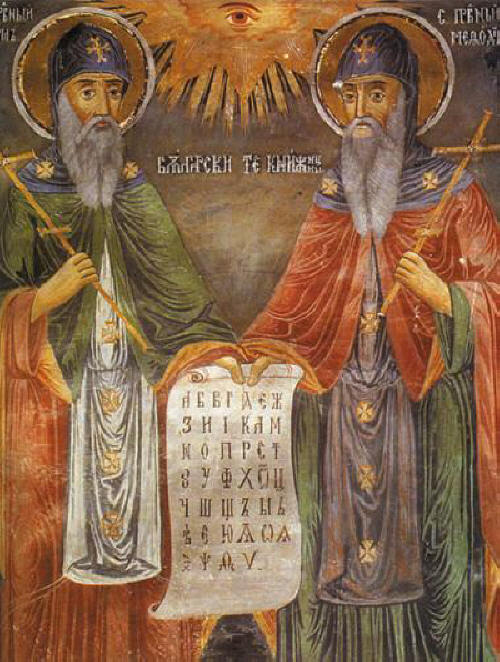
Before Cyrillic or Latin were standardized for Slavic languages, there was Glagolitic (Глагољица). It was created in the 860s by two Byzantine monks and brothers, Saints Cyril and Methodius (Ћирило и Методије). They were tasked with evangelizing the Slavic peoples and needed a way to translate the Greek New Testament and other religious texts. Because the Greek and Latin alphabets could not accurately capture the unique sounds of the Slavic language, Cyril invented the Glagolitic script.
The Rise of Cyrillic
The Cyrillic script emerged toward the end of the 9th century. Its purpose was to simplify the earlier Glagolitic alphabet. It was developed by the disciples of Saints Cyril and Methodius, likely at the Preslav Literary School in the First Bulgarian Empire. This new writing system was influenced by the Greek alphabet. Specifically, it was based on Greek uncial writing, but had adapted letters from Glagolitic to represent unique sounds found in Slavic languages.
Over the following centuries, Cyrillic replaced Glagolitic to become the standard alphabet across Eastern Orthodox Slavic countries. It became the primary script used in Serbia, serving as the sacred script of the Serbian Orthodox Church and the Serbian state.
Over the following centuries, Cyrillic replaced Glagolitic to become the standard alphabet across Eastern Orthodox Slavic countries. It became the primary script used in Serbia, serving as the sacred script of the Serbian Orthodox Church and the Serbian state.
The Religious and Historical Divide
The origins of the dual system trace back to the Great Schism of 1054, which split the Balkans into the Byzantine-Orthodox and Roman-Catholic cultural spheres. Orthodox Serbs traditionally adopted the Cyrillic script, which was tied to the Serbian Orthodox Church, while Catholic populations in the region, such as the Croats, adopted the Latin script. For centuries, these two groups lived side by side and wrote the same language using different scripts.
19th Century Reform
Before the 19th century, the written language used by Serbs was a hybrid called Slavonic-Serbian (or Slavo-Serbian). This mix of Russian Church Slavonic and local dialects was full of outdated letters for sounds people no longer used. The biggest problem was that only the educated elite and church officials could understand it, while the common people could not read or write it.
The Push for a Simpler Cyrillic
The first major attempt to fix this was in 1810 by Sava Mrkalj, who published a booklet proposing to reduce the alphabet to 29 letters. However, he faced harsh opposition from the church and was forced to give up.
Soon after, Vuk Stefanović Karadžić (1787–1864) took up the cause. After moving to Vienna in 1813, he met the Slovenian linguist Jernej Kopitar, who became his mentor. Kopitar introduced Vuk to a simple phonetic rule: Write as you speak and read as it is written. Driven by the desire to create a standard literary language based on everyday folk speech, Vuk published a Serbian grammar book in 1814 and the first Serbian Dictionary in 1818.
Vuk removed all the old, silent letters from the Cyrillic alphabet so that every single sound had exactly one matching letter. He also added six new letters for unique Serbian sounds: Љ, Њ, Ђ, Ћ, Џ, and Ј. Some of these were adapted from old manuscripts, the letter Ђ was designed by poet Lukijan Mušicki, and the letter Ј was borrowed straight from the Latin alphabet.
Soon after, Vuk Stefanović Karadžić (1787–1864) took up the cause. After moving to Vienna in 1813, he met the Slovenian linguist Jernej Kopitar, who became his mentor. Kopitar introduced Vuk to a simple phonetic rule: Write as you speak and read as it is written. Driven by the desire to create a standard literary language based on everyday folk speech, Vuk published a Serbian grammar book in 1814 and the first Serbian Dictionary in 1818.
Vuk removed all the old, silent letters from the Cyrillic alphabet so that every single sound had exactly one matching letter. He also added six new letters for unique Serbian sounds: Љ, Њ, Ђ, Ћ, Џ, and Ј. Some of these were adapted from old manuscripts, the letter Ђ was designed by poet Lukijan Mušicki, and the letter Ј was borrowed straight from the Latin alphabet.
The Latin Alphabet Reform
At the same time, a Croatian linguist named Ljudevit Gaj (1809–1872) was actively reforming the Latin alphabet. Motivated by the Illyrian Movement, which aimed to culturally unite the South Slavic people, Gaj published his new spelling rules in Buda in 1830.
Gaj used the Czech alphabet as a model to add letters with diacritical marks (like č, ž, and š) and created two-letter combinations, called digraphs, like lj, nj, and dž. He perfectly matched his Latin letters to Vuk's new Cyrillic letters, creating an ingenious system where the two alphabets mirror each other exactly.
Gaj used the Czech alphabet as a model to add letters with diacritical marks (like č, ž, and š) and created two-letter combinations, called digraphs, like lj, nj, and dž. He perfectly matched his Latin letters to Vuk's new Cyrillic letters, creating an ingenious system where the two alphabets mirror each other exactly.
Harsh Opposition and Eventual Victory
Vuk’s reform was not welcomed with open arms. It faced fierce resistance for decades, especially from the Serbian Orthodox Church. Church leaders, led by Metropolitan Stefan Stratimirović, felt that removing the old church language was an attack on their sacred traditions. They were especially angry about the Latin letter 'Ј', claiming Vuk was trying to "Catholicize" the Serbs. Conservative writers like Jovan Hadžić also opposed the reform, calling the everyday language of the common people "vulgar" and too rustic for literature.
Despite the heavy pushback, the reformers eventually won. A major turning point happened in 1847, celebrated as the "Year of Vuk". That year, young intellectuals published four masterpieces using the new language and alphabet.
• The New Testament, translated into the reformed language by Vuk Karadžić.
• Pesme (Poems), a collection of poetry written by Branko Radičević.
• Gorski Vijenac (The Mountain Wreath), a famous epic poem by Petar II Petrović-Njegoš.
• Rat za srpski jezik i pravopis (The War for the Serbian Language and Orthography), a scholarly defense of Vuk's reform written by Đuro Daničić.
This proved to everyone that the common language could be used to write great works.
Shortly after, in March 1850, writers and linguists, including Vuk Karadžić, Đuro Daničić, Ljudevit Gaj, and Franz Miklosich, met and signed the historic Vienna Literary Agreement. This agreement officially recognized the everyday Eastern Herzegovinian dialect as the common literary language for both Serbs and Croats, and validated the equal standing of both alphabets.
Finally, in 1868, four years after Vuk's death, his reformed Cyrillic alphabet was officially adopted in the Principality of Serbia, forever changing the way the language was written and securing his legacy.
Despite the heavy pushback, the reformers eventually won. A major turning point happened in 1847, celebrated as the "Year of Vuk". That year, young intellectuals published four masterpieces using the new language and alphabet.
• The New Testament, translated into the reformed language by Vuk Karadžić.
• Pesme (Poems), a collection of poetry written by Branko Radičević.
• Gorski Vijenac (The Mountain Wreath), a famous epic poem by Petar II Petrović-Njegoš.
• Rat za srpski jezik i pravopis (The War for the Serbian Language and Orthography), a scholarly defense of Vuk's reform written by Đuro Daničić.
This proved to everyone that the common language could be used to write great works.
Shortly after, in March 1850, writers and linguists, including Vuk Karadžić, Đuro Daničić, Ljudevit Gaj, and Franz Miklosich, met and signed the historic Vienna Literary Agreement. This agreement officially recognized the everyday Eastern Herzegovinian dialect as the common literary language for both Serbs and Croats, and validated the equal standing of both alphabets.
Finally, in 1868, four years after Vuk's death, his reformed Cyrillic alphabet was officially adopted in the Principality of Serbia, forever changing the way the language was written and securing his legacy.

Even if we ignore the reform, Vuk Stefanović Karadžić (1787–1864) is still a fascinating historical figure.
He was fiercely dedicated to preserving the Serbian culture. He collected everything that he could find: folk songs, stories, proverbs, customs…
This effort preserved much of the Serbian oral tradition that would have otherwise been lost to time.
In addition to documenting folklore, Karadžić wrote biographies of notable Serbs.
If you walk into any Serbian school, there’s a good chance you’ll encounter his picture on the wall.
He was fiercely dedicated to preserving the Serbian culture. He collected everything that he could find: folk songs, stories, proverbs, customs…
This effort preserved much of the Serbian oral tradition that would have otherwise been lost to time.
In addition to documenting folklore, Karadžić wrote biographies of notable Serbs.
If you walk into any Serbian school, there’s a good chance you’ll encounter his picture on the wall.
Serbian Alphabet Cheatsheet (Side-by-side comparison)
| Cyrillic Upper Case | Cyrillic Lower Case | Latin Upper Case | Latin Lower Case | IPA Value | English Approximation |
|---|---|---|---|---|---|
| А | а | A | a | /ä/ | Like "a" in "father" |
| Б | б | B | b | /b/ | Like "b" in "boy" |
| В | в | V | v | /v/ | Like "v" in "very" |
| Г | г | G | g | /ɡ/ | Like "g" in "go" |
| Д | д | D | d | /d/ | Like "d" in "dog" |
| Ђ | ђ | Đ | đ | /d͡ʑ/ | Like "j" in "juice" but softer |
| Е | е | E | e | /ɛ/ | Like "e" in "met" |
| Ж | ж | Ž | ž | /ʐ/ | Like "s" in "pleasure" |
| З | з | Z | z | /z/ | Like "z" in "zebra" |
| И | и | I | i | /i/ | Like "ee" in "see" |
| Ј | ј | J | j | /j/ | Like "y" in "yes" |
| К | к | K | k | /k/ | Like "k" in "kite" |
| Л | л | L | l | /l/ | Like "l" in "love" |
| Љ | љ | Lj | lj | /ʎ/ | Like "lli" in "million" |
| М | м | M | m | /m/ | Like "m" in "mother" |
| Н | н | N | n | /n/ | Like "n" in "nice" |
| Њ | њ | Nj | nj | /ɲ/ | Like "ny" in "canyon" |
| О | о | O | o | /ɔ/ | Like "o" in "or" |
| П | п | P | p | /p/ | Like "p" in "pen" |
| Р | р | R | r | /ɾ/ | Rolled "r" like in Spanish |
| С | с | S | s | /s/ | Like "s" in "sun" |
| Т | т | T | t | /t/ | Like "t" in "top" |
| Ћ | ћ | Ć | ć | /t͡ɕ/ | Like "ch" in "church" but softer |
| У | у | U | u | /u/ | Like "oo" in "boot" |
| Ф | ф | F | f | /f/ | Like "f" in "fun" |
| Х | х | H | h | /x/ | Like "h" in "hello" |
| Ц | ц | C | c | /t͡s/ | Like "ts" in "cats" |
| Ч | ч | Č | č | /t͡ʂ/ | Like "ch" in "check" |
| Џ | џ | Dž | dž | /d͡ʐ/ | Like "j" in "jungle" |
| Ш | ш | Š | š | /ʂ/ | Like “sh” in shoes |
Watch Out: Cyrillic Letters That Look Like English But Sound Different
Some letters in the Cyrillic script resemble English letters, but they make completely different sounds. This is usually the biggest stumbling block for English speakers. For instance, the Cyrillic letter В looks exactly like an English B, but it actually makes a "v" sound. Also, the letter Н looks like an H, but it is really an "n".
| Cyrillic Letter | Looks Like English | Sounds Like |
|---|---|---|
| В | B | V |
| Н | H | N |
| Р | P | R |
| С | C | S |
| У | Y | U |
Using fun visual connections will make it much easier to remember the sounds. Try drawing little pictures next to these tricky Cyrillic letters (Vase for В, Sun for С).
Understanding Digraphs: Lj, Nj, and Dž
Latin script features three special characters known as digraphs. These are Lj, Nj, and Dž. Even though they look like two characters pushed together, they act as single letters in the Latin alphabet. This means that a word like ljubav (love) actually starts with the single letter Lj, not an L followed by a j. The exact same rule applies to words like njuška (snout) beginning with Nj, and džep (pocket) starting with Dž.
There are a few rare cases with compound words where these letters just happen to sit next to each other. For example, in the word injekcija (injection), the n and j are two separate letters because of how the word is built (in-jekcija). It is not spelled with the single letter nj.
There are a few rare cases with compound words where these letters just happen to sit next to each other. For example, in the word injekcija (injection), the n and j are two separate letters because of how the word is built (in-jekcija). It is not spelled with the single letter nj.
Serbian Alphabet Pronunciation Guide
In the previous segments, we covered how the Serbian alphabet became 100% phonetic. Remember the golden rule: Write as you speak, read as it is written. Basically: One letter = one sound.
For English speakers, this is a huge relief. There are no silent letters to trip you up, and you don’t have to memorize any weird spelling exceptions. The sounds are also very crisp and distinct. You will not find any mixed or combined vowel sounds, such as the German "ö" or "ü".
For English speakers, this is a huge relief. There are no silent letters to trip you up, and you don’t have to memorize any weird spelling exceptions. The sounds are also very crisp and distinct. You will not find any mixed or combined vowel sounds, such as the German "ö" or "ü".
Note that a few of these sounds might present a bit of a challenge for English speakers. Let’s examine them:
• The Rolled R (Р): This is not the soft English "r". It is a rolled "r", just like the one used in Spanish.
• Č (Ч) vs. Ć (Ћ): Both of these letters will remind you of the "ch" sound in the English word "church," but they are slightly different. Č is a hard sound, like the "ch" in "check". Ć, on the other hand, is a softer version.
• Dž (Џ) vs. Đ (Ђ): These two have a similar relationship. Dž is a hard sound, similar to the "j" in "jungle". Đ also sounds like a "j," such as in the word "juice".
• Lj (Љ) and Nj (Њ): These letters might look strange, but you already know the sounds. Lj sounds just like the "lli" in the word "million". Nj sounds exactly like the "ny" in the word "canyon".
Of course, practicing with a live tutor is always the fastest way to master pronunciation. Check out Scolingo, our language learning platform, to find the perfect tutor for your needs.
• The Rolled R (Р): This is not the soft English "r". It is a rolled "r", just like the one used in Spanish.
• Č (Ч) vs. Ć (Ћ): Both of these letters will remind you of the "ch" sound in the English word "church," but they are slightly different. Č is a hard sound, like the "ch" in "check". Ć, on the other hand, is a softer version.
• Dž (Џ) vs. Đ (Ђ): These two have a similar relationship. Dž is a hard sound, similar to the "j" in "jungle". Đ also sounds like a "j," such as in the word "juice".
• Lj (Љ) and Nj (Њ): These letters might look strange, but you already know the sounds. Lj sounds just like the "lli" in the word "million". Nj sounds exactly like the "ny" in the word "canyon".
Of course, practicing with a live tutor is always the fastest way to master pronunciation. Check out Scolingo, our language learning platform, to find the perfect tutor for your needs.
How to Learn the Serbian Alphabet: Tips for Beginners
If you’re reading this, then you probably wish to learn the Serbian alphabet. Mastering both scripts might seem difficult, but it is actually quite easy! Let’s discuss some tips and strategies.
Should You Learn Cyrillic or Latin First?
This is likely the most common dilemma for beginners. The best choice really depends on what you already know. If your native language uses the Latin script, like English does, starting with the Serbian Latin alphabet is usually the right idea. You will recognize most of the letters right away, which gives you quick wins and helps you build confidence quickly. Once you are comfortable with the Latin letters and some basic words, you can then safely transition to learning the Cyrillic script.
On the other hand, if you already know a language that uses the Cyrillic script, such as Russian or Bulgarian, you should definitely start with Serbian Cyrillic. Either way, whichever you choose first, the final goal is to eventually learn both.
On the other hand, if you already know a language that uses the Cyrillic script, such as Russian or Bulgarian, you should definitely start with Serbian Cyrillic. Either way, whichever you choose first, the final goal is to eventually learn both.
Practical Learning Strategies
Here are some creative and actionable steps to help you master the Serbian alphabet:
• Group Cyrillic letters by similarity to Latin: Start by learning the letters that look and sound the same in both alphabets, then move on to the "false friends" that look alike but sound different, and finally tackle the completely new Cyrillic shapes.
• Use flashcards with both scripts: Make flashcards featuring the Cyrillic letter on one side and its matching Latin letter on the other. This trains your brain to instantly link the two.
• Write daily journal entries alternating scripts: To build your writing muscle, try writing a few simple sentences every day, using the Latin script one day and the Cyrillic script the next.
• Read children's books in Cyrillic: Children's books use simple vocabulary and large text, making them the perfect tool for beginners practicing their reading speed.
• Practice with a native Serbian tutor on Scolingo: Nothing beats having a real conversation. A dedicated tutor can guide your pronunciation, which is hard to learn when you’re alone. Many tutors have years of experience in teaching Serbian and have figured out exactly which learning techniques work best.
• Group Cyrillic letters by similarity to Latin: Start by learning the letters that look and sound the same in both alphabets, then move on to the "false friends" that look alike but sound different, and finally tackle the completely new Cyrillic shapes.
• Use flashcards with both scripts: Make flashcards featuring the Cyrillic letter on one side and its matching Latin letter on the other. This trains your brain to instantly link the two.
• Write daily journal entries alternating scripts: To build your writing muscle, try writing a few simple sentences every day, using the Latin script one day and the Cyrillic script the next.
• Read children's books in Cyrillic: Children's books use simple vocabulary and large text, making them the perfect tool for beginners practicing their reading speed.
• Practice with a native Serbian tutor on Scolingo: Nothing beats having a real conversation. A dedicated tutor can guide your pronunciation, which is hard to learn when you’re alone. Many tutors have years of experience in teaching Serbian and have figured out exactly which learning techniques work best.
Is the Serbian Alphabet the Same as Russian?
No, the Serbian alphabet is not the same as the Russian alphabet. While both are Slavic languages that use the Cyrillic script, they have distinct differences in their letters and spelling rules.
First, the two alphabets do not have the same number of letters. The Serbian Cyrillic alphabet has exactly 30 letters, while the Russian alphabet has 33 letters.
Second, the Russian alphabet has spelling rules and letters that do not make a sound on their own.
Because of Vuk Karadžić's reforms (which we covered earlier), the Serbian alphabet dropped several letters that are still used in Russian today. If you look at Serbian Cyrillic, you will not find these Russian letters: Ё, Й, Щ, Ъ (the hard sign), Ы, Ь (the soft sign), Э, Ю, and Я. Karadžić removed the hard and soft signs entirely because they were no longer needed to write the everyday spoken Serbian language.
At the same time, the Serbian alphabet features six letters that do not exist in the Russian alphabet. These letters are Ђ, Ћ, Џ, Љ, Њ, and Ј. Karadžić added these letters so that unique Serbian sounds would have their own exact letter match. For example, he made the letters Љ and Њ by combining existing Cyrillic letters with a soft sign, and he borrowed the letter Ј directly from the Latin script.
Finally, there are also some visual differences when the letters are written in italics or cursive handwriting. In the Serbian Cyrillic script, the italic lowercase forms of certain letters, specifically б, г, д, п, and т, look significantly different from how those same letters are written in Russian.
Knowing Russian Cyrillic will certainly give you a helpful head start in learning the Serbian alphabet, but the two are unique writing systems tailored to their specific languages.
First, the two alphabets do not have the same number of letters. The Serbian Cyrillic alphabet has exactly 30 letters, while the Russian alphabet has 33 letters.
Second, the Russian alphabet has spelling rules and letters that do not make a sound on their own.
Because of Vuk Karadžić's reforms (which we covered earlier), the Serbian alphabet dropped several letters that are still used in Russian today. If you look at Serbian Cyrillic, you will not find these Russian letters: Ё, Й, Щ, Ъ (the hard sign), Ы, Ь (the soft sign), Э, Ю, and Я. Karadžić removed the hard and soft signs entirely because they were no longer needed to write the everyday spoken Serbian language.
At the same time, the Serbian alphabet features six letters that do not exist in the Russian alphabet. These letters are Ђ, Ћ, Џ, Љ, Њ, and Ј. Karadžić added these letters so that unique Serbian sounds would have their own exact letter match. For example, he made the letters Љ and Њ by combining existing Cyrillic letters with a soft sign, and he borrowed the letter Ј directly from the Latin script.
Finally, there are also some visual differences when the letters are written in italics or cursive handwriting. In the Serbian Cyrillic script, the italic lowercase forms of certain letters, specifically б, г, д, п, and т, look significantly different from how those same letters are written in Russian.
Knowing Russian Cyrillic will certainly give you a helpful head start in learning the Serbian alphabet, but the two are unique writing systems tailored to their specific languages.
Frequently Asked Questions
How many letters are in the Serbian alphabet?
The Serbian alphabet has exactly 30 letters. This rule applies to both the Cyrillic and Latin writing systems. Because the two scripts mirror each other, every single letter in one alphabet has an exact match in the other.
Is the Serbian alphabet hard to learn?
While the Serbian language is considered difficult to learn, the alphabet itself is surprisingly easy. It is a fully phonetic system, meaning you just read words exactly as they are written. There are no silent letters or confusing spelling exceptions to worry about.
Do all Serbians read both scripts?
Yes, almost all Serbians read and write in both scripts naturally. Children in Serbia are taught both the Cyrillic and Latin alphabets during their first two grades of primary school. Because of this, people often switch between the two writing systems without even thinking about it.
What is the difference between the Serbian and Croatian alphabets?
The only difference is that the Croatian language uses only the Latin script, while the Serbian language uses both Cyrillic and Latin scripts.
Can I get by with just a Latin script in Serbia?
Yes, you can easily get by using only the Latin script. The Latin alphabet is widely used on the internet, on store signs, text messages, menus…
Still, learning Cyrillic is useful for reading official government documents.
Is Serbian Cyrillic the same as Russian Cyrillic?
No, they are different writing systems. The Serbian Cyrillic alphabet has 30 letters, while the Russian alphabet has 33. Serbian dropped several Russian letters and added unique ones, like ђ and џ, to perfectly match its own spoken sounds.
The Serbian alphabet has exactly 30 letters. This rule applies to both the Cyrillic and Latin writing systems. Because the two scripts mirror each other, every single letter in one alphabet has an exact match in the other.
Is the Serbian alphabet hard to learn?
While the Serbian language is considered difficult to learn, the alphabet itself is surprisingly easy. It is a fully phonetic system, meaning you just read words exactly as they are written. There are no silent letters or confusing spelling exceptions to worry about.
Do all Serbians read both scripts?
Yes, almost all Serbians read and write in both scripts naturally. Children in Serbia are taught both the Cyrillic and Latin alphabets during their first two grades of primary school. Because of this, people often switch between the two writing systems without even thinking about it.
What is the difference between the Serbian and Croatian alphabets?
The only difference is that the Croatian language uses only the Latin script, while the Serbian language uses both Cyrillic and Latin scripts.
Can I get by with just a Latin script in Serbia?
Yes, you can easily get by using only the Latin script. The Latin alphabet is widely used on the internet, on store signs, text messages, menus…
Still, learning Cyrillic is useful for reading official government documents.
Is Serbian Cyrillic the same as Russian Cyrillic?
No, they are different writing systems. The Serbian Cyrillic alphabet has 30 letters, while the Russian alphabet has 33. Serbian dropped several Russian letters and added unique ones, like ђ and џ, to perfectly match its own spoken sounds.
Conclusion: Start Your Serbian Alphabet Journey
It is a great time to start learning Serbian! The Serbian alphabet is one of the most logical writing systems in the world due to its strict phonetic nature. With consistent practice, both scripts are easily learnable in just a few days or weeks.
The best way to learn Serbian quickly is to practice with a real person. Book a lesson with Serbian tutor on Scolingo to practice reading and writing in both scripts. Your tutor will guide you through the trickier sounds and help you master the Cyrillic and Latin letters. Take the first step on your language journey today!
The best way to learn Serbian quickly is to practice with a real person. Book a lesson with Serbian tutor on Scolingo to practice reading and writing in both scripts. Your tutor will guide you through the trickier sounds and help you master the Cyrillic and Latin letters. Take the first step on your language journey today!
← Back to Blog
16 min read