The Hardest Languages to Learn, According to the US State Department
SF
Scolingo Founder
11 min read
·
53 views
Published:
November 1, 2026
Updated:
November 6, 2026
Arabic, Chinese, Japanese and Korean take English speakers about twice as long as the next group down. Here are the hours, a lookup for 41 languages, and what "hardest" leaves out.
The hardest languages to learn for English speakers are Arabic, Chinese (Mandarin and Cantonese), Japanese and Korean, according to the US State Department. Its language training pages put these four in a category of their own, "super-hard", and list 88 weeks, or 2,200 class hours, as the typical time to reach professional working ability. That is about twice the time listed for the next group down and about three times what French or Spanish needs. This guide gives the full ranking with weeks and hours, a lookup for 41 languages, what makes the top four slow, and why "hardest" always depends on who is asking.
What is the hardest language to learn?
For a native English speaker, the US State Department's answer is Category IV: Arabic, Chinese (listed as two entries, Mandarin and Cantonese), Japanese and Korean. Its language training page describes them as "super-hard languages", exceptionally difficult for native English speakers, with a typical time of 88 weeks and 2,200 class hours.
Arabic, Chinese, Japanese and Korean take English speakers longest: about 88 weeks, or 2,200 class hours, to reach professional working ability.
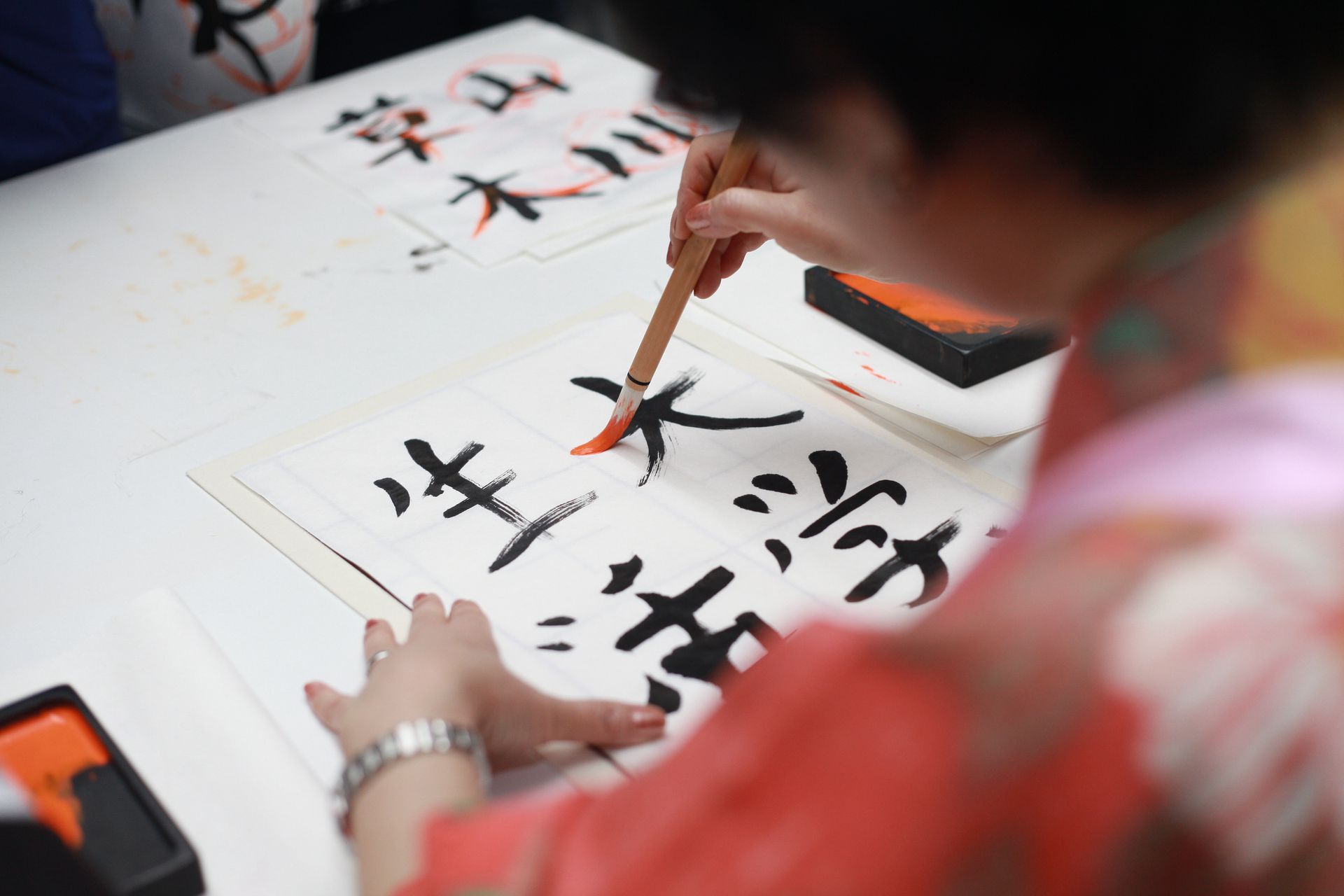
Two limits to know before you read on. The ranking measures difficulty for English speakers, because the figures come from teaching US diplomats. And it counts class time to reach a set level, not how hard a language feels in the first week. Both points matter later in this guide.
Which language is the most difficult to learn?
There is no single winner. The State Department puts Arabic, Mandarin, Cantonese, Japanese and Korean in the same category with the same 88 weeks and 2,200 class hours, and it does not rank them against each other. Any list that crowns one of them as the most difficult language to learn is giving an opinion, often shaped by which language the writer struggled with.
In one sentence: these five are the hardest for English speakers by the only official measure of training time we could find, and that measure does not separate them.
In one sentence: these five are the hardest for English speakers by the only official measure of training time we could find, and that measure does not separate them.
The hardest languages to learn for English speakers: the four categories
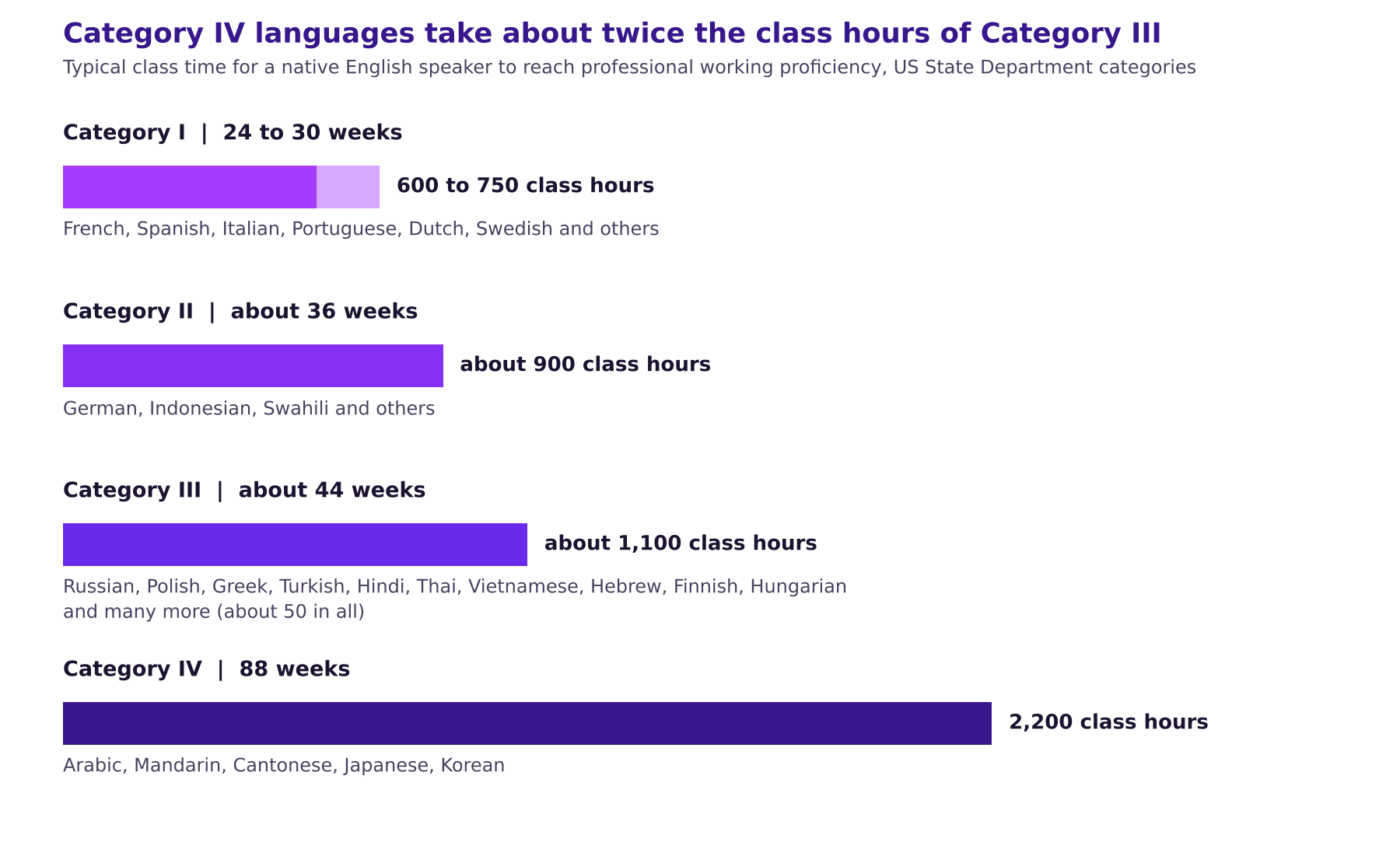
The State Department sorts the languages it teaches into four categories by how long a native English speaker typically needs to reach "General Professional Proficiency", which it equates with Speaking 3 and Reading 3 on the Interagency Language Roundtable scale. Here is how the categories compare.
| Category | State Department description | ColumnTypical time3 | Examples |
|---|---|---|---|
| Category I | Languages similar to English | 24 to 30 weeks (600 to 750 class hours) | French, Spanish, Italian, Portuguese, Dutch, Swedish, Norwegian, Danish, Romanian |
| Category II | Languages that take a little longer than Category I | About 36 weeks (900 class hours) | German, Indonesian, Malay, Swahili, Haitian Creole |
| Category III | "Hard languages", with significant linguistic and cultural differences from English | About 44 weeks (1,100 class hours) | Russian, Polish, Greek, Turkish, Hindi, Thai, Vietnamese, Hebrew, Finnish, Hungarian and about 50 languages in all |
| Category IV | "Super-hard languages", exceptionally difficult for native English speakers | 88 weeks (2,200 class hours) | Arabic, Chinese (Mandarin), Chinese (Cantonese), Japanese, Korean |
The page says Category III is not an exhaustive list. The hours and category descriptions come from the State Department's Foreign Language Training page as archived for 2021 to 2025. The longer lists of language names come from an archived State Department language list from 2009 to 2017, and the 3/3 level from a 2015 State Department document. The live page may have changed since, and the archived copies differ slightly: one lists Spanish at 30 weeks and another at 24, so this guide gives Category I as a range rather than picking a number for Spanish.
One piece of arithmetic that the page does not state: every category works out to 25 class hours a week (1,100 hours over 44 weeks, 2,200 over 88). That is our calculation. The page gives only the totals, and no hours-per-week figure.
One piece of arithmetic that the page does not state: every category works out to 25 class hours a week (1,100 hours over 44 weeks, 2,200 over 88). That is our calculation. The page gives only the totals, and no hours-per-week figure.
How the State Department measures language difficulty
The figures come from the Foreign Service Institute, the State Department's training school. The Foreign Language Training page describes them as averages drawn from 76 years of experience teaching US diplomats, and says the real time varies with a learner's natural ability, prior experience with languages and time spent in class.
The target level is defined by the Interagency Language Roundtable. Level 3 speaking reads: "Able to speak the language with sufficient structural accuracy and vocabulary to participate effectively in most formal and informal conversations in practical, social and professional topics." That is a working level, not fluency in the everyday sense, and not a beginner's goal of ordering lunch.
Three things follow. The hours are class hours from teaching US diplomats, so they are a yardstick for comparing languages, not a stopwatch for a self-taught learner. The categories assume a native English speaker. And a language can be Category III and still feel easy on day one, because the scale measures the distance to a professional level, not the first lessons.
Is there a top 10 of the hardest languages to learn?
Not an official one. The State Department has five entries in Category IV, and about 50 languages in Category III, all with the same 44 weeks. Nothing on the page ranks Hungarian against Polish, or Thai against Turkish. A true top 10 would need the five Category IV languages plus five picked from Category III, and any pick would be a guess.
That is why published top 10 lists differ after the first four or five names. The lists from two language-learning publishers that we read agree on Arabic, Mandarin, Japanese and Korean, then diverge. If a list claims to rank the rest with confidence, ask what measure it used.
What you can say with evidence is this: five languages sit at the top, a large group sits one step below at half the time, and French, Spanish and their relatives sit at the bottom. The lookup table further down shows where 41 languages land.
The hardest four, one by one
Is Chinese hard to learn?
The State Department lists Mandarin and Cantonese as two separate entries, each at 88 weeks and 2,200 class hours. One feature that sets Mandarin apart for English speakers is tone. According to Britannica, Mandarin uses four tones (level, rising, falling and high-rising) to distinguish syllables that have the same consonants and vowels but different meanings. English does not use pitch to tell words apart, so a learner has to hear and produce the same syllable in four ways.
Is Japanese hard to learn?
Writing is a large part of why Japanese has a reputation for difficulty. Japan's government list of everyday kanji, the Jōyō kanji, was revised in November 2010 and now contains 2,136 characters, after 196 were added and five removed. That list sits alongside the two kana syllabaries, so a reader of Japanese handles three kinds of writing in one sentence.
Is Korean hard to learn?
Korean is the interesting counterexample. Its alphabet, Hangul, is traditionally ascribed to King Sejong and became the official writing system in 1446. Britannica gives it 24 letters, made up of 14 consonants and 10 vowels. That is 24 letters, against the 2,136 characters on Japan's everyday kanji list. Yet the State Department still puts Korean in Category IV, so whatever makes it slow for English speakers is not the size of its alphabet.
Is Arabic hard to learn?
Arabic has a feature that most language courses have to work around: diglossia. As a Cambridge University Press chapter on the subject describes it, the standard language, fuṣḥā, is used for writing and formal speech, while a colloquial variety, called ʿāmmiyya (dārija in North Africa), is used for informal speech. In practice, a learner who wants to read the news and chat with neighbors is dealing with two related varieties, not one.
All four share the same listed time: 2,200 class hours, or about 88 weeks.
All four share the same listed time: 2,200 class hours, or about 88 weeks.
Is Russian hard to learn? Is French? Where 41 languages fall
The long tail of "is it hard to learn" questions has a simple answer for most languages: find the category. The table below uses the State Department's language list and its hours. A language the pages do not name is marked as such. That does not make it easy or hard. It means the pages we read do not rate it, and the list is not exhaustive.
| Language | State Department category | Typical weeks | Typical class hours |
|---|---|---|---|
| French | I | 24 to 30 | 600 to 750 |
| Spanish | I | 24 to 30 | 600 to 750 |
| Italian | I | 24 to 30 | 600 to 750 |
| Portuguese | I | 24 to 30 | 600 to 750 |
| Dutch | I | 24 to 30 | 600 to 750 |
| Swedish | I | 24 to 30 | 600 to 750 |
| Romanian | I | 24 to 30 | 600 to 750 |
| German | II | 36 | 900 |
| Swahili | II | 36 | 900 |
| Haitian Creole | II | 36 | 900 |
| Russian | III | 44 | 1,100 |
| Ukrainian | III | 44 | 1,100 |
| Greek | III | 44 | 1,100 |
| Turkish | III | 44 | 1,100 |
| Hindi | III | 44 | 1,100 |
| Urdu | III | 44 | 1,100 |
| Thai | III | 44 | 1,100 |
| Vietnamese | III | 44 | 1,100 |
| Hebrew | III | 44 | 1,100 |
| Persian (Farsi) | III | 44 | 1,100 |
| Finnish | III | 44 | 1,100 |
| Hungarian | III | 44 | 1,100 |
| Icelandic | III | 44 | 1,100 |
| Tagalog | III | 44 | 1,100 |
| Georgian | III | 44 | 1,100 |
| Serbian, Croatian and Bosnian (listed as Serbo-Croatian) | III | 44 | 1,100 |
| Arabic | IV | 88 | 2,200 |
| Mandarin | IV | 88 | 2,200 |
| Cantonese | IV | 88 | 2,200 |
| Japanese | IV | 88 | 2,200 |
| Korean | IV | 88 | 2,200 |
| English | Not rated | Not rated | Not rated |
| Latin | Not rated | Not rated | Not rated |
| Welsh | Not rated | Not rated | Not rated |
| Basque | Not rated | Not rated | Not rated |
| Navajo | Not rated | Not rated | Not rated |
Where a language you care about sits in Category I, such as French, Spanish or Italian, the State Department's wording is "similar to English", and the typical time is a quarter to a third of the Category IV figure. Category III is the large middle: Russian, Polish, Greek, Turkish, Hindi, Thai, Vietnamese, Hebrew, Finnish, Hungarian and dozens more, all at 44 weeks. Category II holds German at about 36 weeks.
Serbian, Croatian and Bosnian are listed under one entry, Serbo-Croatian, in Category III. For the Serbian side of that entry, the writing system is a good first step: The Serbian Cyrillic Alphabet: All 30 Letters and Their Latin Twins
Serbian, Croatian and Bosnian are listed under one entry, Serbo-Croatian, in Category III. For the Serbian side of that entry, the writing system is a good first step: The Serbian Cyrillic Alphabet: All 30 Letters and Their Latin Twins
Which European language is the hardest to learn?
The State Department does not rank within Category III, so it does not say. The European languages in that category include Russian, Polish, Czech, Ukrainian, Greek, Finnish, Hungarian and Icelandic, all at about 44 weeks. The Romance languages in Category I are French, Spanish, Italian, Portuguese and Romanian. French sits at the longer end of Category I on both pages we read, at 30 weeks, while Italian, Portuguese and Romanian are listed at 24. The pages disagree about Spanish, so we do not call it.
Is English the hardest language to learn?
No ranking we opened puts English at the top, and the State Department's list does not rate English at all, because its categories measure difficulty for native English speakers. What exists is narrower evidence.
A 2003 study in the British Journal of Psychology, by Philip Seymour, Mikko Aro and Jane Erskine, compared how quickly children learn to read English and 12 other European writing systems. Children in most of the countries became accurate and fluent in foundation-level reading within the first school year. French, Portuguese and Danish were slower, and English most of all. The authors reported that reading development in English was more than twice as slow as in the languages with the most regular spelling, and attributed it to syllable complexity and orthographic depth, meaning how irregularly spelling maps to sound. That is about children learning to read their own language, not about adults learning English as a second language.
For adults, distance from the learner's first language is what matters. Economists Barry Chiswick and Paul Miller built a measure of the distance between English and other languages from how hard Americans find them to learn. Using it, they found that among adult immigrants in the United States and Canada, the greater the linguistic distance, the poorer the respondent's English proficiency. So English is hardest for speakers of languages far from it, and easier for speakers of close ones.
What is the hardest language to learn for non-English speakers?
There is no official equivalent for other starting languages that we could open. The State Department's categories are for English speakers, and the Chiswick and Miller distance measure is also built from English. Both of the measures we found start from English.
What they imply is that difficulty follows distance from the languages you already speak. A French speaker and an English speaker will not agree on how far Spanish, Russian or Japanese is from home. If you do not speak English natively, the English-speaker rankings are a rough guide at best, and the most useful question is which languages sit closest to yours.
What they imply is that difficulty follows distance from the languages you already speak. A French speaker and an English speaker will not agree on how far Spanish, Russian or Japanese is from home. If you do not speak English natively, the English-speaker rankings are a rough guide at best, and the most useful question is which languages sit closest to yours.
What is the hardest language in the world?
"Hardest to learn" and "hardest language" sound like the same question, but they are two. The first is about a learner's time. The second would be about the language itself, and we did not find a measure that ranks languages by inherent complexity independent of the learner. The two measures we opened, the State Department's and Chiswick and Miller's, both start from the English-speaking learner. That is why the Category IV list is the right answer to "hardest language to learn for English speakers" and the wrong answer to "hardest language in the world".
Both measures we found start from English, so neither can say which language is hardest in the world.
How long does it take to learn the hardest languages?
The State Department's figures translate to calendar time once you pick a daily routine. The table below is our arithmetic: class hours divided by hours per day, using 365 days a year. It assumes every hour counts as a class hour, which a self-study hour often does not, so treat it as a lower bound for someone studying alone.
| Class hours per day | Category I (up to 750 hours) | Category II (900 hours) | Category III (1,100 hours) | Category IV (2,200 hours) |
|---|---|---|---|---|
| 30 minutes | about 4 years | about 5 years | about 6 years | about 12 years |
| 1 hour | about 2 years | about 2.5 years | about 3 years | about 6 years |
| 2 hours | about 1 year | about 1.2 years | about 1.5 years | about 3 years |
| 4 hours | about 6 months | about 7 months | about 9 months | about 1.5 years |
The searches "how long does it take to learn Japanese", "Mandarin" and "Arabic" all land on the same State Department figure: 2,200 class hours. At one hour a day that is about six years. At two hours a day it is about three. Where self-study, speaking practice and a teacher fit into those hours is covered in [LINK: How to Learn a New Language (and How Long It Takes)].
And the easiest languages for English speakers?
Category I, the group the State Department calls "similar to English", holds the languages with the shortest listed times: French, Spanish, Italian, Portuguese, Dutch, Swedish, Norwegian, Danish and Romanian, at 24 to 30 weeks. Those are the shortest times the State Department lists.
Where to go from here
If you are weighing a language by difficulty, use the lookup table to find its category, then ask the more personal question: how many hours a day can you actually give it? For practice with a real person in the language you pick, you can Browse teachers. For tools to build the daily habit, see Best Language Learning Apps in 2026.
← Back to Blog
11 min read