How to Learn a New Language (and How Long It Takes)
SF
Scolingo Founder
9 min read
·
24 views
Published:
November 4, 2026
Updated:
November 6, 2026
Hours decide how long it takes, and spacing and self-testing decide how many of those hours count. Here are the real numbers, the methods with research behind them, and a 30-day plan.
How to learn a new language comes down to three things: enough hours, spread over time, with a lot of that time spent testing yourself rather than rereading. The hours are the part most people underestimate. The US State Department lists 24 to 30 weeks (600 to 750 class hours) for languages closest to English and 88 weeks (2,200 class hours) for the hardest. Cambridge English puts the climb from complete beginner to a B2 level at about 500 to 600 guided hours. The sections below cover how long it takes, how to speed it up, what the research says works, whether you can do it alone or as an adult, and a plan for your first 30 days.
The short answer
Most people need hundreds of hours, not weeks. A language close to English, such as Spanish or French, takes about 600 to 750 class hours to reach professional working level, according to the US State Department. The hardest languages for English speakers, such as Japanese or Arabic, take about 2,200. How fast you get there depends on how many hours a day you can give it, and how well you use them.
Hours decide how long it takes, and spacing and self-testing decide how many of those hours count.

The research behind the second half of that sentence is covered under the best way to learn, below. First, the numbers.
How long does it take to learn a new language?
There are two official-looking scales, and they measure different things. One is the US State Department's, built for English-speaking diplomats. The other is Cambridge English's guided learning hours for each level of the CEFR, the European scale that runs from A1 to C2.
The State Department scale: four categories
The Foreign Service Institute sorts languages into four categories by how long a native English speaker typically needs to reach "General Professional Proficiency", which it equates with Speaking 3 and Reading 3 on the Interagency Language Roundtable scale. Its Foreign Language Training page, as archived for 2021 to 2025, gives these totals.
| Category | Typical time | Class hours | Examples |
|---|---|---|---|
| Category I, similar to English | 24 to 30 weeks | 600 to 750 | French, Spanish, Italian, Portuguese, Dutch, Swedish |
| Category II | About 36 weeks | About 900 | German, Indonesian, Swahili |
| Category III, hard languages | About 44 weeks | About 1,100 | Russian, Polish, Greek, Turkish, Hindi, Thai, Vietnamese |
| Category IV, super-hard languages | 88 weeks | 2,200 | Arabic, Mandarin, Cantonese, Japanese, Korean |
The page says the figures are averages from 76 years of teaching US diplomats and that the real time varies with natural ability, prior language experience and time in class. For the full ranking and a lookup of 41 languages, see The Hardest Languages to Learn, According to the US State Department.
A second scale: hours per CEFR level
Cambridge English publishes approximate guided learning hours for each CEFR level. They are cumulative, counted from complete beginner, and Cambridge describes them as a guideline only. It also says moving from one level to the next takes roughly 200 guided hours. Cambridge publishes them for learners of English. The CEFR levels themselves are not specific to one language, so treat them as a rough guide for any language rather than a promise.
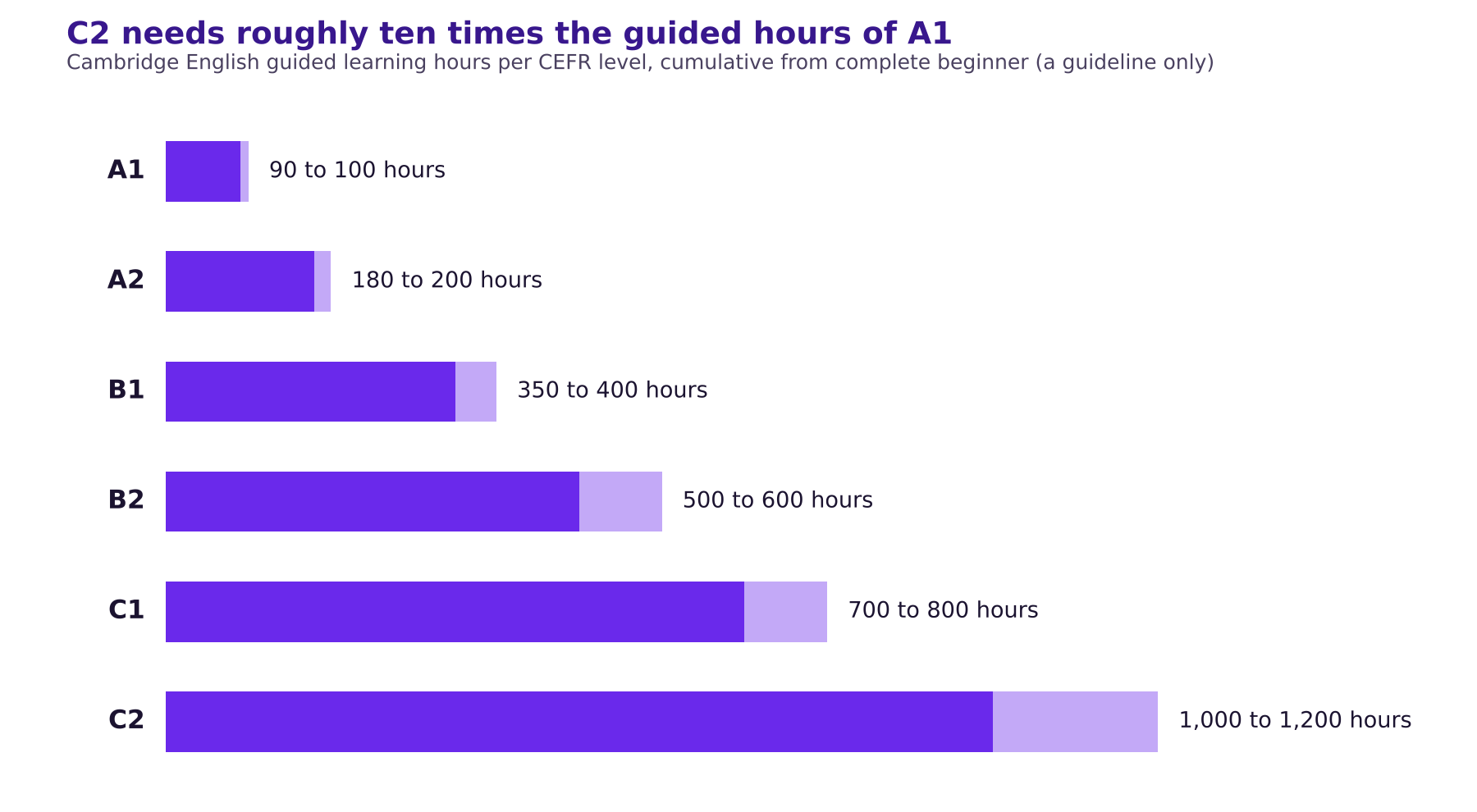
| CEFR level | Cumulative guided hours | Rough meaning |
|---|---|---|
| A1 | 90 to 100 | Beginner |
| A2 | 180 to 200 | Elementary |
| B1 | 350 to 400 | Intermediate |
| B2 | 500 to 600 | Upper intermediate |
| C1 | 700 to 800 | Advanced |
| C2 | 1,000 to 1,200 | Proficient |
Three things these numbers do not say
They are class or guided hours, which are not the same as hours with a phone in your hand. Neither scale promises fluency in the everyday sense. And both are averages, so your own time will be shorter or longer depending on your first language, your experience of learning languages and how much you practice outside lessons. Cambridge lists age and study intensity among the factors too.
What those hours look like on your calendar
The table below is our arithmetic: hours divided by hours per day, on a 365-day year, with every hour counted as a study hour. Real life has days off, so treat each cell as a minimum.
| Time per day | 400 hours (about B1) | 600 hours (about B2) | 750 hours (Category I) | 1,100 hours (Category III) | 2,200 hours (Category IV) |
|---|---|---|---|---|---|
| 30 minutes | about 2.2 years | about 3.3 years | about 4 years | about 6 years | about 12 years |
| 1 hour | about 1 year | about 1.5 years | about 2 years | about 3 years | about 6 years |
| 2 hours | about 7 months | about 10 months | about 1 year | about 1.5 years | about 3 years |
| 4 hours | about 3 months | about 5 months | about 6 months | about 9 months | about 1.5 years |
At one hour a day, a Category I language such as Spanish takes about two years to reach the State Department's professional level. At four hours a day, about six months. The same four hours a day on a Category IV language such as Japanese is about a year and a half.
How to learn a new language fast
There is no shortcut in the sources we could open. The State Department's timetables work out to 25 class hours a week (our calculation: 1,100 hours over 44 weeks, 2,200 over 88), so the quickest documented route is also the most intensive one. To learn a new language quickly, raise the hours per day, and make each hour count with the methods in the next section.
Two sizes of speed-up are realistic. One is more hours a day, which the calendar table above shows directly. The other is better hours: spacing your practice and testing yourself. A claim of fluency in 30 days or three months has no support in the scales above, so be careful with courses that make one.
Two sizes of speed-up are realistic. One is more hours a day, which the calendar table above shows directly. The other is better hours: spacing your practice and testing yourself. A claim of fluency in 30 days or three months has no support in the scales above, so be careful with courses that make one.
Can you learn a language while sleeping?
Not from scratch. Thomas Schreiner and Björn Rasch of the universities of Zurich and Fribourg tested 60 German-speaking students who learned pairs of Dutch and German words at 10 p.m. Half then went to sleep, and some of the Dutch words they had learned were played back quietly while they slept. The sleepers remembered the German translations of the replayed words better. The study, published in Cerebral Cortex in 2014, found that the method only works on words learned before going to sleep. In Schreiner's words, "You can only successfully activate words that you have learned before you go to sleep." The results came from a controlled laboratory.
You cannot learn a language from scratch in your sleep, but you can strengthen words you already studied.
What is the best way to learn a language? Four ideas with evidence behind them
No single method wins every comparison. What the research supports most strongly is how you practice, not which brand of course you buy. These four ideas have evidence behind them.
1. Test yourself instead of rereading
In 2013, John Dunlosky and colleagues reviewed ten study techniques in Psychological Science in the Public Interest. Practice testing, meaning quizzing yourself on what you studied, and distributed practice received the highest overall utility rating. Summarization, highlighting and rereading received the lowest. Dunlosky said: "By just replacing rereading with delayed retrieval practice, students would benefit." For language learning, that means covering the translation and recalling the word, not rereading the list.
2. Spread your practice over days and weeks
The University of Rochester's Learning Center says spaced study is "hands down more likely to lead to durable memories", and that twelve hours spread over two weeks typically beats twelve hours in one day. On that evidence, spreading the same hours across the week beats one long session.
3. Read and listen to material where you know most of the words
Researchers who study vocabulary and comprehension have looked at how many words you need to know in a text to understand it. Van Zeeland and Schmitt (2012) concluded that 95 percent coverage was the more reasonable criterion for adequate comprehension of listening. Paul Nation's 2006 frequency counts put the vocabulary needed for 98 percent coverage of written English at about 8,000 to 9,000 word families, and for spoken English about 6,000 to 7,000. Those figures come from counting words in text collections, not from testing learners, and they are about English. The practical point holds for any language: material that is mostly made of words you know is where reading and listening teach you the rest.
4. Drop the low-value habits
Highlighting, rereading and writing summaries came out lowest in Dunlosky's review. If you spend your study time highlighting vocabulary lists and rereading notes, swap that time for recall, spaced review and real material.
How to learn a new language by yourself
You can do most of this alone, because the best-supported ideas above need nothing but time and a method. A plain setup works: one main resource, a spaced review habit with flashcards or a notebook, and daily reading or listening at your level. A comparison of the tools is in Best Language Learning Apps in 2026
The one thing studying alone cannot supply is a person who answers back. Speaking practice with a teacher or a conversation partner is where mistakes show up and get fixed. When you are ready for that, you can Browse teachers
If your language uses a new alphabet, the alphabet is a sensible first week. The Serbian Cyrillic Alphabet: All 30 Letters and Their Latin Twins shows what learning a script from scratch looks like.
Learning a language as an adult: is it too late?
It depends what you mean by learning. A 2018 study in Cognition by Joshua Hartshorne, Joshua Tenenbaum and Steven Pinker used an online English grammar quiz taken by 669,498 native and non-native speakers. Their model suggests that the ability to learn grammar stays largely intact until about 17.4 years old and then declines. They estimate that someone who wants native-like grammar should start by about age 10.
The same study does not say adults cannot learn. MIT's write-up says learners who start between 10 and 18 still learn quickly, and that adults can still learn foreign languages well, though they generally will not reach native-level grammar if they start as teenagers or adults. The researchers say it is unknown what causes the change, and that culture and changes in brain plasticity may both play a role. This was a study of English grammar, so it does not tell you how far an adult can get in vocabulary, listening or conversation.
So the honest answer is that it is too late for one thing, native-like grammar, and not too late for what most adults want: to read, travel, work or talk with people in another language.
Is learning a new language good for your brain?
The evidence is thinner than the headlines. A 2021 systematic review in Frontiers in Aging Neuroscience, by Ware and colleagues, found nine studies of second-language learning in later life, with 622 participants in total. The results were inconsistent, but they tended to suggest gains in attentional switching, inhibition and working memory. Only one study used brain imaging. The authors describe the quality of the studies as fair at best and call for more research.
That makes the supported claim a modest one: there are some indications of cognitive benefits from learning a language in later life. It does not show that bilingualism prevents memory loss, and the review does not cover younger adults.
That makes the supported claim a modest one: there are some indications of cognitive benefits from learning a language in later life. It does not show that bilingualism prevents memory loss, and the review does not cover younger adults.
Your first 30 days: a 20-minutes-a-day plan
This plan applies the ideas above: short daily sessions, self-testing, and real material. It is our own design, not a published program, so adjust the details to your language.
| Days | Your 20 minutes |
|---|---|
| 1 to 3 | Choose one language and one main resource. Learn the alphabet or the sounds if they are new to you. |
| 4 to 10 | 10 minutes of new words or phrases, 5 minutes testing yesterday's words from memory, 5 minutes of listening. |
| 11 to 20 | Add one short real text or audio clip a day where you know most of the words. Keep the daily self-test. |
| 21 to 25 | Say or write five sentences a day using words from the past three weeks, then check them. |
| 26 to 30 | Review the words you got wrong most often, then book or arrange one real conversation, even a short one. |
At 20 minutes a day, 30 days is 10 hours. That is not enough to reach A1 by the Cambridge hours, which start at 90 to 100, but it is enough to build the habit that gets you there.
Where you go after that is a question of hours, and the calendar table above shows what each daily amount adds up to.
Where you go after that is a question of hours, and the calendar table above shows what each daily amount adds up to.
← Back to Blog
9 min read