Is Serbian Hard to Learn? And How Long It Takes
SF
Scolingo Founder
7 min read
·
43 views
Published:
November 12, 2026
Updated:
November 19, 2026
Yes for English speakers, but in a predictable way: spelling is easy, and the seven cases and verb pairs are hard. Here is what is hard, what is easy, and how many hours it takes to reach each level.
Is Serbian hard to learn? For an English speaker, yes, but in a specific and predictable way. The US State Department puts Serbo-Croatian, the group Serbian belongs to, in Category III, "hard languages," at about 44 weeks or 1,100 class hours to reach professional working proficiency. The spelling is the easy part. The endings are the hard part: Serbian nouns change in seven cases, and you meet that in your first week. This guide shows what is hard, what is easy and how many hours each level takes, so you can plan around real numbers.
Is Serbian hard to learn for English speakers?
Parts of it are hard, and parts are easier than English. The table below rates nine features of Serbian, and the ratings are our judgment, based on the descriptions in Wikipedia's articles on Serbo-Croatian grammar and phonology.
| Feature | <span style="white-space: nowrap;">Our rating</span> | Why |
|---|---|---|
| Spelling | Easy | 30 letters in each alphabet, largely written as pronounced |
| Vowels | Easy | Five vowels |
| Articles | Easy | There is no word for a or the |
| Word order | Easy | Usually subject, verb, object, as in English |
| Cases | Hard | Seven cases change the endings of nouns and adjectives |
| Gender | Medium | Three genders, and adjectives must match the noun |
| Verbs | Medium to hard | Perfective and imperfective pairs, and four tenses in everyday use |
| Pitch accent | Hard to master, low priority | Four accents that ordinary writing does not mark |
| Counting | Medium | 2, 3 and 4 take one noun form, 5 and above another |
Most of the effort goes into endings, not into sounds or word order.
Serbian is easy to read aloud and hard to inflect.

How hard is Serbian? What the State Department says
The one official measure is the US State Department's Foreign Service Institute, which groups languages by how long English-speaking diplomats need to reach professional working proficiency, Speaking-3 and Reading-3 on the Interagency Language Roundtable scale. Serbo-Croatian is named in Category III. The page does not name Serbian separately.
| Category | Time | <span style="white-space: nowrap;">Class hours</span> | In the State Department's words |
|---|---|---|---|
| I | <span style="white-space: nowrap;">24–30 weeks</span> | <span style="white-space: nowrap;">600–750</span> | Languages more similar to English |
| II | About 36 weeks | 900 | Five languages, no description given |
| III (Serbo-Croatian) | About 44 weeks | 1,100 | "Hard languages," with significant linguistic and/or cultural differences from English |
| IV | 88 weeks | 2,200 | "Super-hard languages," exceptionally difficult for native English speakers |
Against that scale, Serbian needs 350 to 500 hours more than Category I and half the time of Category IV, by our arithmetic. The page gives no weekly schedule, but 1,100 hours in 44 weeks works out to 25 class hours a week. It also says actual time varies with natural ability, prior linguistic experience and time spent in the classroom. For the full lookup of languages by category, see The Hardest Languages to Learn, According to the US State Department.
What makes Serbian hard?
Cases come first. A case is the ending that shows what a noun is doing in the sentence, and Serbian has seven: nominative, genitive, dative, accusative, vocative, locative and instrumental. A name shows it clearly. Ana becomes Ane, Ani, Anu, Ano and Anom as its job changes, so seven cases give six different forms of one name. Pronouns, adjectives and numbers change as well.
Gender adds a second layer. Serbian has three genders, and adjectives match the noun: dobar grad (a good city), dobra kafa (good coffee), dobro vino (good wine).
Verbs add a third. Most Serbian verbs come in pairs: an imperfective verb for an ongoing or repeated action and a perfective one for a completed action. Čitati and pročitati both mean "to read," but Čitao sam knjigu says you were reading or read the book, and Pročitao sam knjigu says you finished it. Wikipedia's grammar article lists seven tenses, of which four are used in contemporary speech, so the load is lighter than the count suggests.
Two things sound harder than they are. Pitch accent: Wikipedia's phonology article describes four accents, made from two tones and vowel length, and says stress can fall on any syllable but rarely the last. Most speakers from Serbia and Croatia do not distinguish the short rising and short falling accents, and some southern Serbian dialects have no length or pitch accent at all, so treat it as something to listen to, not to memorise. Counting: after 2, 3 and 4 the noun takes the genitive singular, a remnant of the old dual number, and after 5 it takes the genitive plural, so you say dva grada but pet gradova.
What makes Serbian easy to learn?
Reading is the big win. Wikiwand's article on the Serbian language says Vuk Karadžić reformed Serbian writing in 1814, and each alphabet has 30 letters, so a learner masters one sound system in two shapes. The sound system itself is small: Wikipedia's phonology article counts five vowels and 25 consonants, and a handful of sounds, such as č, ć, đ, dž, š and ž, need practice. The spelling is not perfectly phonemic. The same article says vowel length matters but is not written, and some voicing changes in speech are not shown on the page. For a beginner this rarely causes problems.
Grammar has easy parts too. There are no articles, so there is no "the" to get wrong, and the usual word order is subject, verb, object, as in English. Both scripts are in use, but the two map one to one, which is why The Serbian Cyrillic Alphabet: All 30 Letters and Their Latin Twins is a first-week job.
How long does it take to learn Serbian?
The State Department figure is 1,100 class hours, which is about three years at one hour a day, by our arithmetic. Your daily time decides the calendar, as the chart shows.
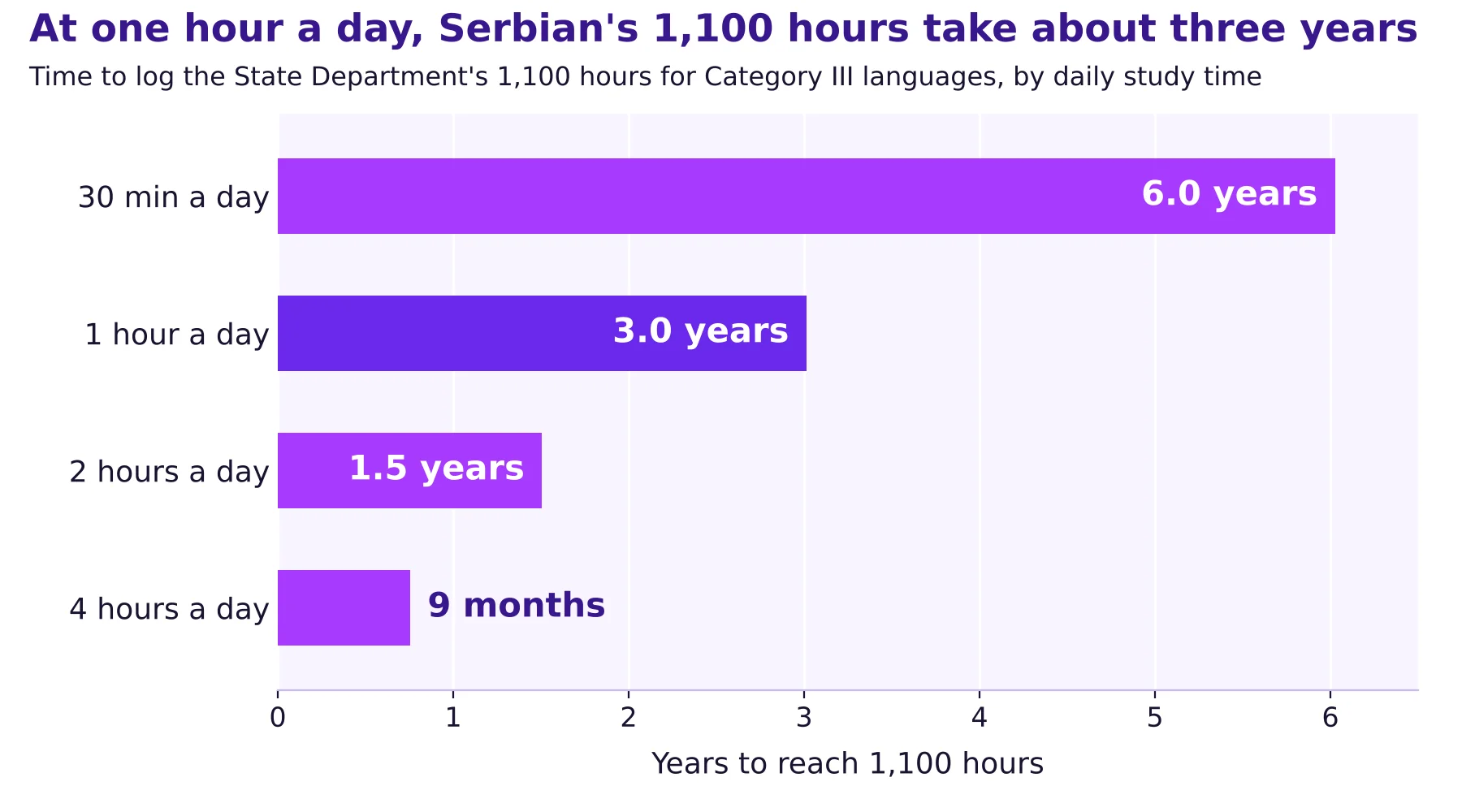
Those are class hours for professional working proficiency, a high target. The State Department counts class hours, so your own study hours are a rough stand-in and not an exact equivalent. For lower levels, use Cambridge English's approximate guided learning hours from a complete beginner: 90 to 100 for A1, 180 to 200 for A2 and 350 to 400 for B1. Cambridge says the figures are a guideline only, and they come from English exams, so use them as a rough scale, not a Serbian measure.
| Time at 1 hour a day | Hours | Closest Cambridge level |
|---|---|---|
| 30 days | 30 | Below A1 |
| 3 months (90 days) | 90 | About A1 |
| 6 months (180 days) | 180 | About A2 |
| 1 year (365 days) | 365 | About B1 |
| 3 years (1,100 days) | 1,100 | The State Department's Category III figure |
How many hours do you need? Roughly 90 for A1, 180 for A2 and 350 for B1, then about 750 more beyond B1 to reach 1,100. For what to study in those first hours, see How to Learn Serbian: A Realistic Plan.
Can you learn Serbian in 30 days or 3 months?
You can start, but not finish. Thirty days at one hour a day is 30 hours, short of the 90 to 100 that Cambridge lists for A1. Three months at one hour a day is about 90 hours, enough, in our judgment, for the alphabet, a few dozen phrases and basic sentences. That is a good first stage and not a conversation level. If you want a faster pace, the way to get one is more hours per week, not a trick, and How to Learn a New Language (and How Long It Takes) covers what the research says about doing that.
Is Serbian easier if you already speak a Slavic language?
It can help, by degrees. The State Department page lists prior linguistic experience among the things that change learning time. A 2015 study by Golubović and Gooskens in Russian Linguistics tested how well young adult native speakers of six Slavic languages understood each other. Croatian speakers got 74% of written Slovene words right but only 44% of written Polish words. The study did not test Serbian, but it shows that closeness within the Slavic family varies a lot, so a Slavic background helps more with some languages than with others. If you speak none, you are starting from the same place as every other English speaker.
How do you make Serbian easier?
Spend your hours on the hard parts, in order. Learn the letters first, the 12 survival phrases second, and the cases inside fixed phrases such as u Beogradu (in Belgrade) and bez šećera (without sugar), not from tables. Start with nominative and accusative, and add the rest as you meet them.
Then use methods that work. A 2013 review by Dunlosky and colleagues rated practice testing and distributed practice as the study techniques with the highest overall utility, and rated highlighting and rereading low. For Serbian, that means spaced flashcards and writing sentences from memory. Speak early too: a tutor can correct your cases in minutes, which is hard to do alone. If you want that check, you can Browse teachers.
Where to go from here
If you want the plan, start with How to Learn Serbian: A Realistic Plan, which sets out 12 weeks of study at 45 minutes a day. If you are still choosing a language, The Hardest Languages to Learn, According to the US State Department puts Serbian next to every other language on the State Department's list.
Scolingo Authors
Scolingo authors are experienced language teachers, linguists, psychologists, and pedagogical specialists with years of experience in schools, universities, and online education. With advanced degrees and expertise across multiple languages, many are also published authors and educational materials creators, combining academic knowledge with practical teaching experience.
← Back to Blog
7 min read