Serbian A1 to B2: A Roadmap of What to Study at Each Level
SF
Scolingo Founder
7 min read
·
54 views
Published:
November 12, 2026
Updated:
November 19, 2026
What to study at each Serbian level, from A1 to B2: the grammar, words and skills to add, with Cambridge's guided hours and the months each level takes at one hour a day.
Serbian A1 is the first of four levels that cover most of what a learner needs: A1, A2, B1 and B2. Each one asks for different things. At A1 you read both alphabets and handle simple exchanges. At A2 you add the past and future and three more cases. At B1 you tell stories and give opinions. At B2 you read and talk without strain. This roadmap says what to study at each level, in order, and how many hours each takes: about 100 for A1, about 200 for A2, about 400 for B1 and about 600 for B2, which is 16 to 20 months at one hour a day.
What are the Serbian language levels?
There is no separate Serbian scale. Serbian uses the Common European Framework of Reference for Languages, which the Council of Europe launched in 2001 and which splits learners into six levels: A1 and A2 (basic), B1 and B2 (independent) and C1 and C2 (proficient). Serbian courses use these levels too. The Faculty of Philology's Center for Serbian as a Foreign Language at the University of Belgrade, for example, teaches a beginner course aimed at A1 after the first semester and A2 after the second, then an intermediate course aimed at B1 and then B2, in 90-minute classes four times a week.
The framework describes each level by what you can do. The summaries below paraphrase the global scale as reproduced on a British Council page.
| Level | What the framework says you can do |
|---|---|
| A1 | Understand and use familiar everyday expressions and very basic phrases, introduce yourself, and interact simply if the other person speaks slowly and helps |
| A2 | Understand frequently used expressions about shopping, family, local geography and work, and handle simple, routine exchanges |
| B1 | Understand the main points of clear standard speech on familiar matters, deal with most travel situations, and describe experiences, plans and opinions in simple connected text |
| B2 | Understand the main ideas of complex text, interact with enough fluency that talking with native speakers is possible without strain, and write clear, detailed text on a wide range of subjects |

How many hours does each Serbian level take?
Cambridge English publishes approximate guided learning hours for each level, counted from a complete beginner and cumulative. They are 90 to 100 for A1, 180 to 200 for A2, 350 to 400 for B1 and 500 to 600 for B2. Cambridge says the figures are a guideline only and link them to lessons and supervised study. They are written for English exams, so treat them as a rough scale, not a Serbian measure.
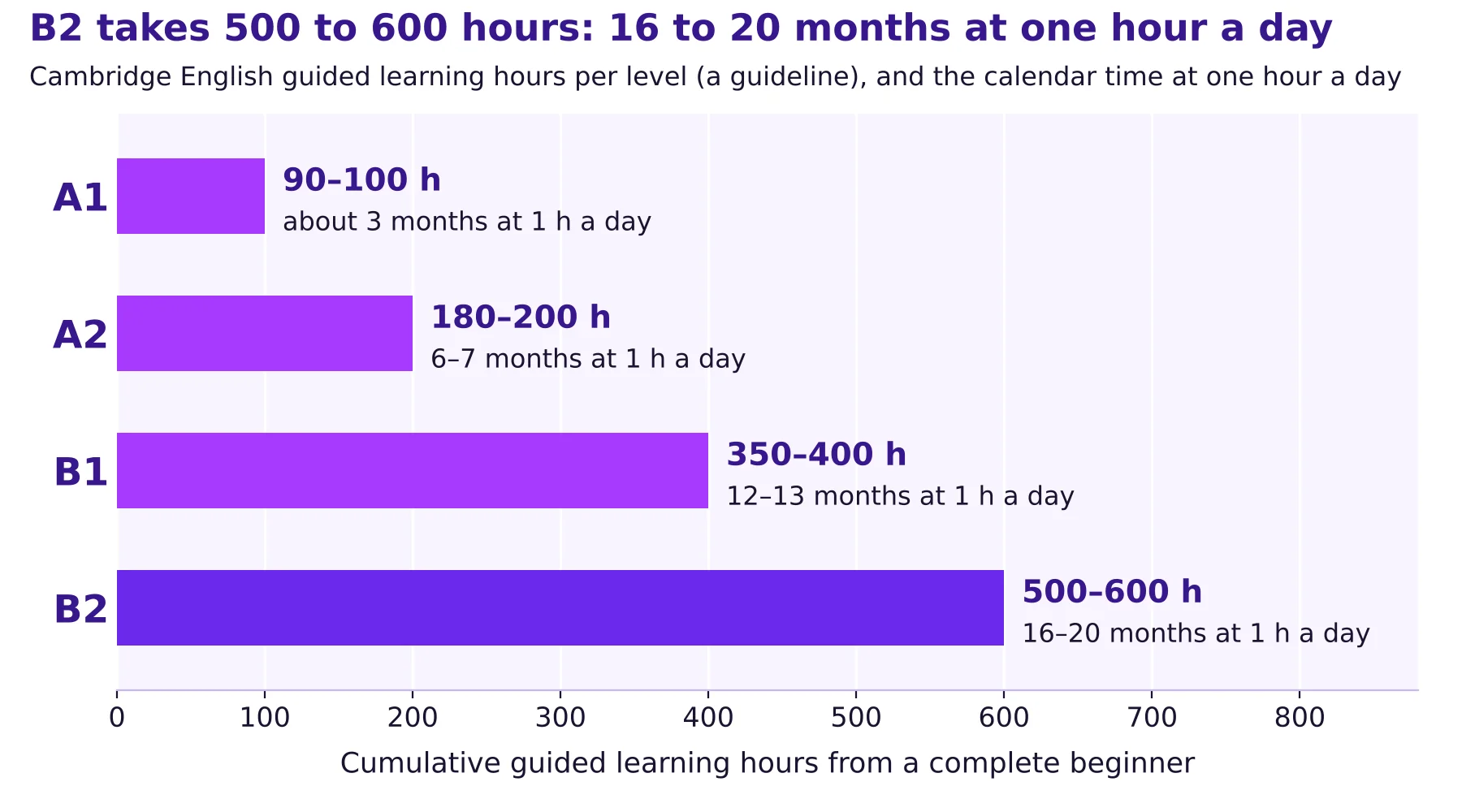
The months come from our arithmetic, dividing the hours by 30.4 days a month at one hour a day. At 45 minutes a day, the pace of the 12-week plan in How to Learn Serbian: A Realistic Plan, each level takes about a third longer. For the official difficulty rating of Serbian and what 1,100 class hours means, see Is Serbian Hard to Learn? And How Long It Takes.
What do you study at Serbian A1?
Serbian A1 is about getting the basics into your head in a usable order. The goal is the 90 to 100 hours that cover the alphabet, the first phrases and the first grammar.
Letters and sounds come first. Learn all 30 pairs in both alphabets, as set out in The Serbian Cyrillic Alphabet: All 30 Letters and Their Latin Twins, and the sounds č, ć, đ, dž, š and ž.
Phrases next: greetings, thanks, ordering, prices and numbers 1 to 10, then your first 400 words from the 12-week plan.
The grammar is deliberately small. Learn "to be" (sam, si, je, smo, ste, su), the present tense of about ten common verbs, the three genders, the nominative and the accusative, and the contrast between Živim u Beogradu (I live in Belgrade) and Idem u Beograd (I am going to Belgrade). Add negation with ne and questions with da li.
You are done when you can say about yourself where you are from, what you want and what something costs: Zovem se Ana. Ja sam iz Amerike. Hoću kafu. Koliko košta?
What do you study at Serbian A2?
A2 adds time and relationships between people and things. The goal is the 180 to 200 cumulative hours, so about 90 to 100 more than A1.
The big additions are the past tense, built from sam and a participle that agrees with the speaker (išao for a man, išla for a woman), and the future with ću and the infinitive. Add three more cases: the genitive (iz Beograda, bez šećera), the instrumental (s tobom) and the dative (dajem ti knjigu), so you now use six of the seven. Learn the counting rule: after 2, 3 and 4 the noun takes the genitive singular, as in dva grada, and after 5 it takes the genitive plural, pet gradova.
Start noticing aspect pairs such as čitati and pročitati, and add the imperative and reflexive verbs. Topics are shopping, directions, family, health, work and weather.
You are done when you can say what you did yesterday and what you will do tomorrow: Juče sam išao u grad. Sutra ću ići u Novi Sad. Idem s prijateljem.
What do you study at Serbian B1?
B1 is where Serbian stops being a list of phrases. The goal is 350 to 400 cumulative hours, and the framework asks for connected speech about experiences, plans and opinions.
Finish the case system. Add the vocative, the last of the seven, and use all of them in the plural as well as the singular. Add the conditional (Kad bih imao vremena, putovao bih češće, "If I had time, I would travel more often"), subordinate clauses with da and relative clauses with koji, comparatives and superlatives, and modal expressions such as moram and treba da.
The new skill is choosing aspect on purpose, so Čitao sam knjigu (I was reading the book) and Pročitao sam knjigu (I finished it) mean different things to you before you say them.
Read short stories and news for non-specialists and hold a 20-minute conversation with a tutor.
You are done when you can explain a plan and give a reason for it: Želim da putujem u Srbiju jer volim muziku i hranu.
What do you study at Serbian B2?
B2 is about control and nuance. The goal is 500 to 600 cumulative hours, and the framework describes interaction with enough fluency that talking with native speakers is possible without strain.
Grammar gets finer. Add the second future (Ako budem imao vremena, pročitaću celu knjigu do petka, "If I have time, I will read the whole book by Friday"), passive participles, reported speech and long sentences with connectors. Wikipedia's grammar article lists seven tenses, of which four are in everyday use. At B2 learn to recognise the aorist, the imperfect and the pluperfect when you read, and leave producing them for later.
Style matters now. Choose between ti and vi on purpose, build words from roots, learn idioms, and notice Ekavian and Ijekavian forms such as mleko and mlijeko when you hear them.
You are done when you can read an article, follow a fast conversation, and argue a view.
Which script should you use at each level?
Use Latin if you like at the start, and plan to write Cyrillic by B2. You can read both from week 1, and everyday Serbian uses both. The University of Belgrade's Center for Serbian as a Foreign Language is stricter in its exam regulations: papers are printed in Cyrillic, A1, A2 and B1 may be completed in Latin, B2 must be completed in printed or cursive Cyrillic, and C1 and C2 in cursive Cyrillic. If you plan to sit that exam, start writing Cyrillic by hand at B1.
How do you know which Serbian level you are at?
Try the tasks in order and stop at the first one you cannot do without help. These are our own checks, based on the descriptions above.
| Level | Can you do this in Serbian? | Example |
|---|---|---|
| A1 | Introduce yourself and order | Zovem se Ana. Jednu kafu, molim. |
| A2 | Say what you did yesterday and what you will do tomorrow | Juče sam bio u Novom Sadu. Sutra idem na posao. |
| B1 | Describe a hypothetical and explain a choice | Kad bih imao vremena, putovao bih češće. |
| B2 | Plan around a condition and finish a task by a time | Ako budem imao vremena, pročitaću celu knjigu do petka. |
If you stop at A1 or A2, spend your hours on the next level's grammar and add 10 minutes of listening a day. If you stop at B1, add reading. The study methods in How to Learn a New Language (and How Long It Takes) apply at every level.
Where to go from here
If you are at A1, start with How to Learn Serbian: A Realistic Plan, which covers the first 12 weeks. From A2 on, a tutor who can check your cases is the fastest way to find the gaps: Browse teachers.

Scolingo Authors
Scolingo authors are experienced language teachers, linguists, psychologists, and pedagogical specialists with years of experience in schools, universities, and online education. With advanced degrees and expertise across multiple languages, many are also published authors and educational materials creators, combining academic knowledge with practical teaching experience.
← Back to Blog
7 min read