How Many Languages Are There in the World? The Number and Why Sources Disagree
SF
Scolingo Founder
6 min read
·
54 views
Published:
November 12, 2026
Updated:
November 19, 2026
Ethnologue's website gives 7,164 living languages, but other guides print 7,139, 7,159 or 7,170. Here is the current number, why counts differ, which countries have the most languages, how many are endangered and how many language families there are.
How many languages are there in the world? About 7,100, according to Ethnologue, the main catalogue of the world's languages. Its website gives 7,164 languages in use today and says the count is constantly in flux. Other guides print slightly different figures, because there is no single agreed line between a language and a dialect and different databases count differently. This guide gives the number, explains why sources disagree, shows which countries have the most languages, and covers how many are endangered and how many language families there are.
How many languages are there in the world?
About 7,100 living languages. Ethnologue's website, which we read on 6 November 2026, says "7,164 languages are in use today." The page does not state which edition that figure comes from, so treat it as the current figure on that site rather than a dated count. Our World in Data, which publishes Ethnologue's data from the 29th edition (2026), describes the source only as "over 7,000 living languages."
Ethnologue's website gives 7,164 living languages today, and says the count is constantly in flux.
If you need one number to quote, say "about 7,100 languages, according to Ethnologue" and name the source. A bare figure such as 7,164 suggests a precision that the counting does not have, as the next section explains.
How many languages exist, and why do sources disagree?
Search for the answer and you will find several figures. The guides we read give 7,139, 7,159, 7,164 and 7,170, and each cites Ethnologue. We could not tell from those pages which edition each figure comes from, and Ethnologue itself says the count changes as it learns more about the world's languages and as languages change. Differences of a few dozen between guides fit that, though we cannot say which edition each one used.
Three bigger reasons are behind any gap between sources:
What counts as a language. Linguists have no single agreed line between a language and a dialect, and tests such as whether speakers understand each other do not settle every case. Chinese varieties and the Scandinavian languages are common examples where the answer depends on the test.
What counts as living. Our World in Data, using Ethnologue's definition, counts a language as living if it is not extinct. That includes languages no longer spoken as a first language but still tied to a community's identity, and languages used only as a second language. A Statista chart we read counts a language as living if at least one person speaks it as a first language. The two definitions give different totals.
Who is counting. Glottolog, a major alternative to Ethnologue, includes only languages its editors have confirmed as both existing and distinct. Wikipedia's description says it is more conservative about grouping languages into families and more permissive about treating unclassified languages as isolates. We did not find a verified Glottolog total for living languages, so we do not give one.
How many languages are spoken in the world?
The number is large, but the speakers are concentrated. Ethnologue says 23 languages cover more than half of humanity, and about 40% of the languages are endangered. Our guide to What Is the Most Spoken Language in the World? The Top 20, Ranked shows which languages those are and how many speakers each has.
By region, Ethnologue says Asia has the most indigenous languages, closely followed by Africa, and that the two together hold nearly two thirds of the world's languages. The Pacific has 18.5% of the world's languages. The Pacific, North America and South America together hold more than a third. We did not find a per-continent count we could verify, so we give the shares Ethnologue states and not numbers.
Measure
Figure
Source
Living languages
7,164
Ethnologue website, read 6 November 2026
Languages that cover more than half of humanity
23
Ethnologue website
Share of languages that are endangered
about 40%
Ethnologue website
Share of languages in Asia and Africa together
nearly two thirds
Ethnologue
Share of languages in the Pacific
18.5%
Ethnologue
Spoken language families and isolates
421
Glottolog edition 4.8, via Wikipedia
Sign languages
223
Glottolog, via Wikipedia, version not stated
Pidgins
84
Glottolog, via Wikipedia, version not stated
Which countries have the most languages?
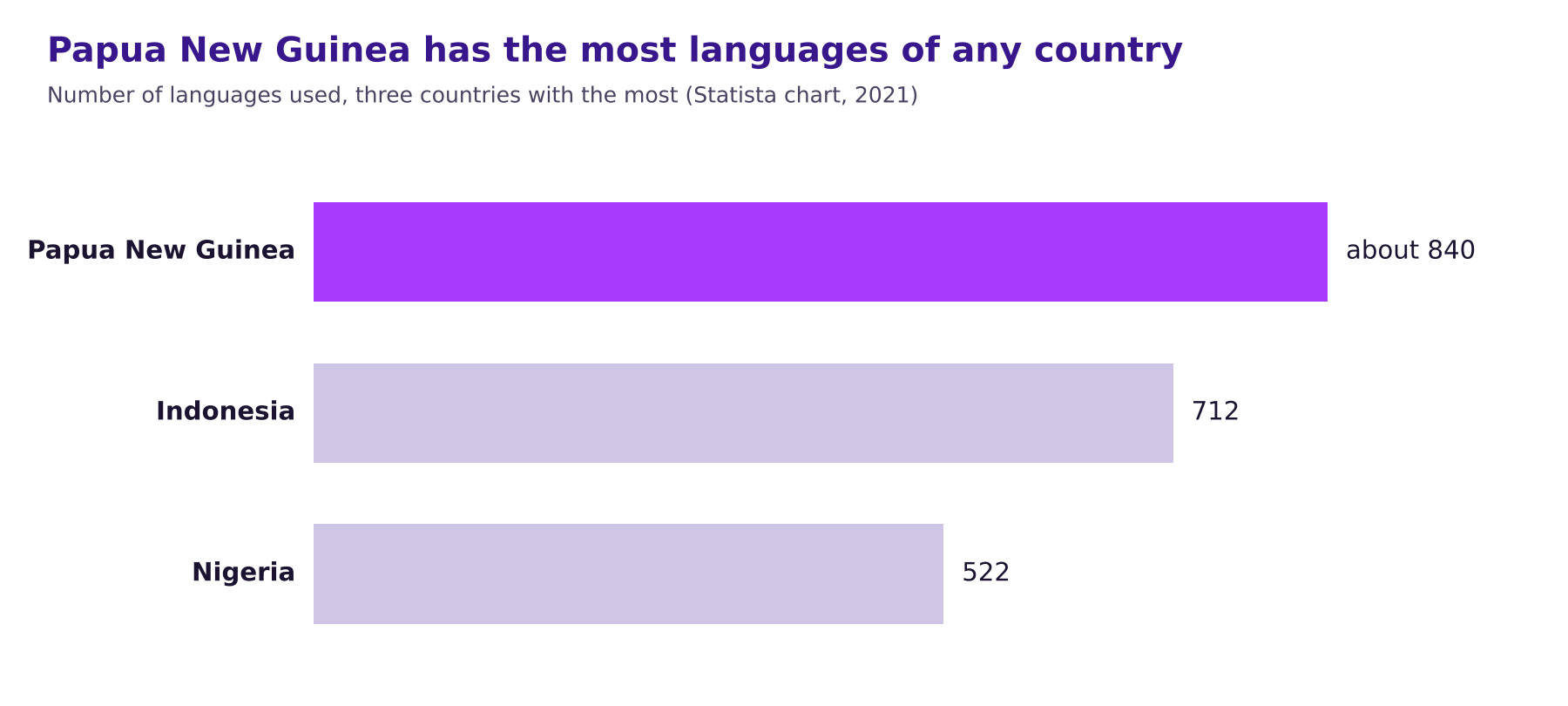
Papua New Guinea has the most, with approximately 840 languages used. Indonesia has about 712 and Nigeria 522, according to a Statista chart for 2021. The chart does not name its source for the country counts, so treat them as approximate and as a 2021 snapshot.
Ethnologue adds a comparison: Papua New Guinea alone has more than twice the number of languages spoken across all of Europe. Our World in Data notes that Ethnologue's counts are assigned per country, so a language spoken in several countries is counted in each, and country figures added together will not give the world total.
How many languages are endangered?
About 40%, according to Ethnologue's website, which describes endangered languages as often having fewer than 1,000 users remaining. That is the only endangered figure we could trace to Ethnologue itself.
Other guides give different numbers: some say nearly half, and some print specific counts such as 3,193. We could not confirm those against Ethnologue, and one guide we read gives both "nearly half" and "roughly 40 percent" in the same piece. For anything you plan to quote, check the figure on Ethnologue's site, and note that, according to Our World in Data, Ethnologue classes living languages as institutional, stable or endangered by how likely they are to be passed on.
How many language families are there?
It depends on how much evidence you require before calling two languages related. Glottolog's edition 4.8 lists 421 spoken language families and isolates, and its latest version, 5.3, was released in March 2026. An isolate is a language with no demonstrated relatives. Glottolog also lists 223 sign languages, 121 attested languages it could not classify and 84 pidgins separately, as non-genealogical groupings, according to Wikipedia's description of the database.
We did not find an Ethnologue family count we could verify, and we did not read Glottolog's own pages for the current figure, so treat 421 as the count for edition 4.8 only.
Scolingo authors are experienced language teachers, linguists, psychologists, and pedagogical specialists with years of experience in schools, universities, and online education. With advanced degrees and expertise across multiple languages, many are also published authors and educational materials creators, combining academic knowledge with practical teaching experience.