The Most Useful Languages to Learn (and How to Pick Yours)
SF
Scolingo Founder
7 min read
·
5 views
Published:
November 6, 2026
Updated:
November 7, 2026
No ranking can say which language is most useful for you, but the data narrows it down. Here are the numbers on speakers, jobs, websites and study time, and a table that matches a language to your goal.
The most useful languages to learn depend on what you want to do with them, but the data narrows the field to a short list: Spanish, Mandarin Chinese, French, Arabic, Hindi, Portuguese, Russian and German. These are the best languages to learn if you count speakers, official use at the United Nations, websites, US job listings and study time, and only Spanish combines a top-three speaker count, the largest website and job-listing shares we found, and the shortest study time. If you are asking what language should I learn, the sections below compare the options, show what each costs in study hours, and end with a table that matches a language to your goal.
What are the most useful languages to learn?
There is no single ranking that fits everyone, because "useful" depends on where you live, what work you do and who you want to talk to. What can be measured is how many people speak a language, how much it is used at the United Nations, on websites and in job listings, and how long it takes a native English speaker to learn. The table puts those side by side for the 12 languages with the most speakers after English (Ethnologue's ranks 2 to 13).
Only Spanish combines a top-three speaker count, the largest website and job-listing shares in the data, and the shortest study time.

English is left out because it leads on speakers (1,530 million in total) and on websites (49.5%), and it is a UN official language. If English is not your first language, it is the strongest candidate on this scorecard. The rest of this guide assumes you already speak it.
| Language | Total speakers (millions) | UN official language | Share of websites | Share of US job listings, 2015 | State Department study time |
|---|---|---|---|---|---|
| Mandarin Chinese | 1,183 | Yes | Not found | 0.13% | 88 weeks (2,200 class hours) |
| Hindi | 611 | No | Not found | Not found | 44 weeks (1,100 class hours) |
| Spanish | 561 | Yes | 6.1% | 1.64% | 24 to 30 weeks (600 to 750 class hours) |
| Arabic (Modern Standard) | 335 | Yes | Not found | 0.03% | 88 weeks (2,200 class hours) |
| French | 334 | Yes | 4.5% | 0.08% | 24 to 30 weeks (600 to 750 class hours) |
| Bengali | 274 | No | Not found | Not found | Not rated |
| Portuguese | 269 | No | Not found | Not found | 24 to 30 weeks (600 to 750 class hours) |
| Indonesian | 255 | No | Not found | Not found | 36 weeks (900 class hours) |
| Urdu | 246 | No | Not found | Not found | 44 weeks (1,100 class hours) |
| Russian | 210 | Yes | Not found | Not found | 44 weeks (1,100 class hours) |
| German | 133 | No | 5.9% | Not found | 36 weeks (900 class hours) |
| Japanese | 126 | No | 5.1% | Not found | 88 weeks (2,200 class hours) |
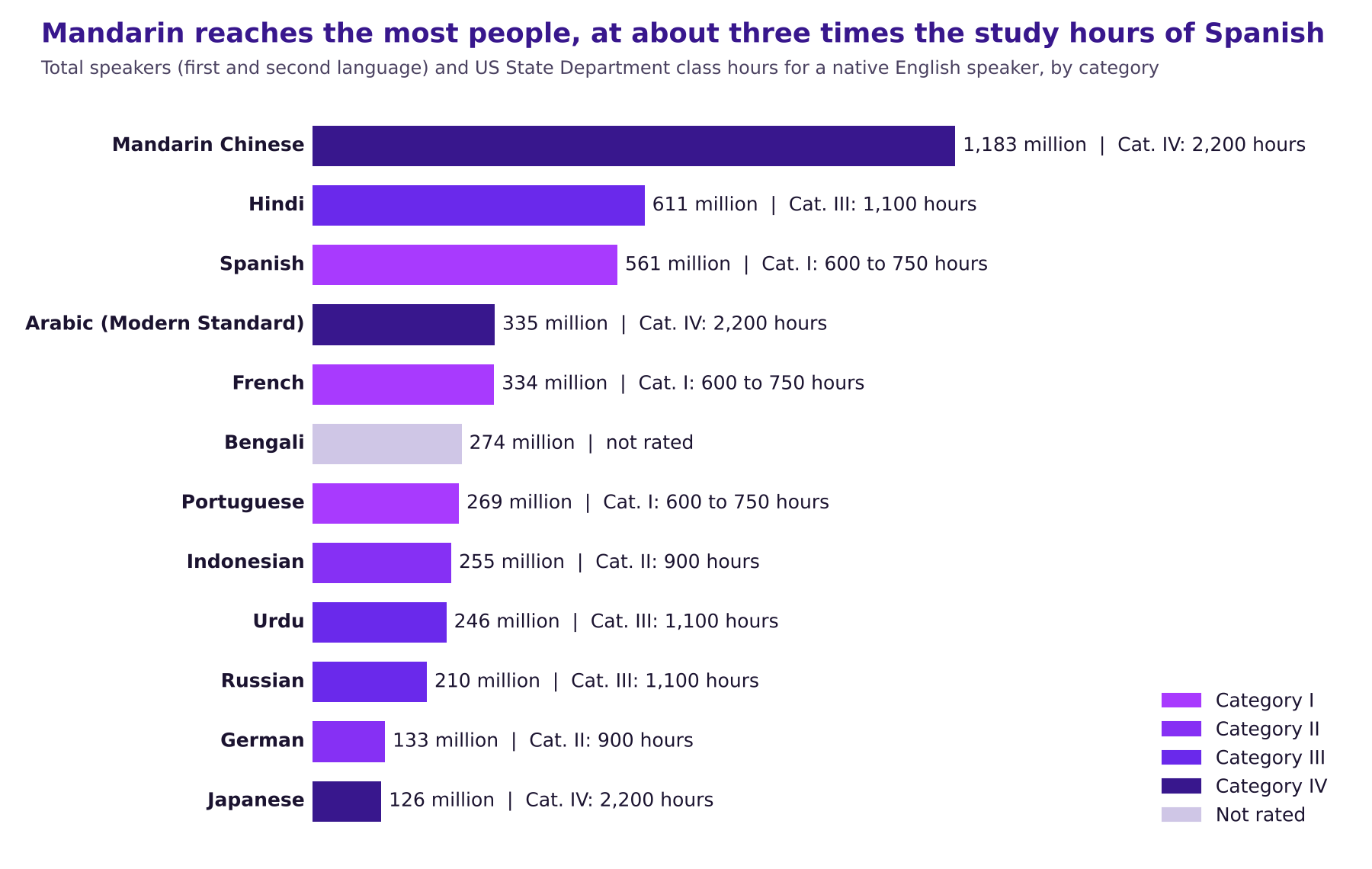
Mandarin reaches the most people, at about three times the study hours of Spanish.
Four things stand out. Mandarin Chinese has by far the most speakers, but sits in the State Department's hardest category, at 2,200 class hours. Spanish has 561 million speakers, 6.1% of websites and the largest share of US bilingual job listings, for 600 to 750 hours. French takes the same time as Spanish and has fewer speakers (334 million). And for several large languages, including Hindi, Bengali, Urdu and Indonesian, the sources we read had nothing on jobs or websites, so the table can say how many people speak them but not how useful they are for work.
The United Nations has six official languages: Arabic, Chinese, English, French, Russian and Spanish. Of the six, Spanish and French are in the shortest study category, Russian is in the middle, and Arabic and Chinese are in the longest.
The United Nations has six official languages: Arabic, Chinese, English, French, Russian and Spanish. Of the six, Spanish and French are in the shortest study category, Russian is in the middle, and Arabic and Chinese are in the longest.
What are the most useful languages to learn for business?
The best US evidence we found is a 2017 report by New American Economy, Not Lost in Translation, which counted online job listings that asked for bilingual workers. Between 2010 and 2015 those listings rose from 239,267 to 627,182, and their share of all online listings went from 1.9% to 2.3%. The report says employers added bilingual jobs faster than jobs overall, especially for Chinese, Spanish and Arabic speakers.
| Language | Share of all US listings, 2010 | Share of all US listings, 2015 | Change in share |
|---|---|---|---|
| Spanish | 1.45% | 1.64% | +12.6% |
| Chinese | 0.09% | 0.13% | +45.5% |
| French | 0.08% | 0.08% | +3.5% |
| Korean | 0.02% | 0.03% | +10.1% |
| Arabic | 0.03% | 0.03% | +14.5% |
The shares are rounded, so the changes do not always match the rounded figures. Spanish had by far the most listings, with more than 178,000 in 2015, and Chinese was next with more than 11,000. Chinese grew fastest in share.
Customer service representatives had the most bilingual listings (46,948, or 7.8% of the total), followed by wholesale sales representatives (6.3%), retail salespersons (6.1%), registered nurses (3.2%) and financial services sales agents (3.2%). Fifteen of the top 25 occupations were open to candidates without a bachelor's degree. By language, Spanish listings were most common in financial services and auto parts, Chinese in luxury retail and hospitality, French in the humanitarian sector, and Korean in pharmaceuticals, education, telecommunications and banking.
If your work is online, W3Techs' count of website content languages is a second angle. English is 49.5% of the websites it tracks, Spanish 6.1% and German 5.9% (1 November 2026). In its ranking of the top 1,000 sites, the shares are 61.2%, 10.4% and 8.2%. An April 2025 W3Techs figure puts Japanese at 5.1% and French at 4.5%.
Two limits apply. The job data are US listings from 2010 to 2015, and we did not find a newer edition, so read them as a pattern, not as today's count. And they cover the US only, so for work in another country the same question needs local data. Within those limits, Spanish is the language the data shows most often for US employers, Chinese is smaller but grew fastest, and for a website audience Spanish and German come right after English.
Which languages are most useful for Americans?
The US Census Bureau's 2018 to 2022 American Community Survey found that 78.3% of people age 5 and older spoke only English at home. Of those who spoke another language, 61.1% spoke Spanish, 5.1% spoke Chinese (all dialects) and 2.5% spoke Tagalog, including Filipino.
Those percentages are shares of non-English speakers, not of everyone. By our arithmetic, Spanish speakers are about 13% of all people age 5 and older, Chinese speakers about 1%, and Tagalog speakers about 0.5%. For an American, Spanish is the language most likely to turn up at home, at work and in job listings. Outside the US, the same method works with your own country's census or labor data.
Those percentages are shares of non-English speakers, not of everyone. By our arithmetic, Spanish speakers are about 13% of all people age 5 and older, Chinese speakers about 1%, and Tagalog speakers about 0.5%. For an American, Spanish is the language most likely to turn up at home, at work and in job listings. Outside the US, the same method works with your own country's census or labor data.
What language should I learn? Start with your goal
If you have to choose, start from what you want to do, not from a ranking. The table matches common goals to the languages the data points to. Where the data has nothing to say, the table says so.
| Your goal | Look first at | What the data shows | State Department study time |
|---|---|---|---|
| Work in the US in customer service, healthcare, finance or retail | Spanish | The most US bilingual job listings (more than 178,000 in 2015) and the most common non-English home language in the US | 24 to 30 weeks (600 to 750 class hours) |
| Reach the most people worldwide | Mandarin Chinese | 1,183 million speakers, the most of any language in the table; Chinese job listings in the US grew fastest, mostly in luxury retail and hospitality | 88 weeks (2,200 class hours) |
| Work at the UN or in diplomacy | One of the UN's other official languages: Arabic, Chinese, French, Russian or Spanish | They are the UN's six official languages along with English | 600 to 2,200 class hours, depending on the language |
| Work in the humanitarian sector | French | French listings in the 2017 US report were concentrated in the humanitarian sector | 24 to 30 weeks (600 to 750 class hours) |
| Work with web content or online audiences | Spanish, German, Japanese or French | The biggest website shares after English: 6.1%, 5.9%, 5.1% and 4.5% | 600 to 750 hours (Spanish, French), 900 (German), 2,200 (Japanese) |
| Get to a working level fastest | Spanish, French, Portuguese or Italian | The State Department's Category I, its shortest listed time | 24 to 30 weeks (600 to 750 class hours) |
| English is not your first language | English | 1,530 million speakers, 49.5% of websites and a UN official language | Not rated |
| Family, one country, or curiosity | The language of the place or people you will actually use it with | No dataset here can answer this one | Look up its category |
The last row matters most. In our view, a language you keep using is worth more than a more useful one you drop, and none of the measures above can tell you which you will keep. A good test is to name the first real conversation, trip or task you want it for, and pick the language that gets you there.
Best languages to learn when time is your limit
The State Department's typical times are class hours, so they are a yardstick for comparing languages, not a stopwatch for a self-taught learner. Category I languages (French, Spanish, Italian, Portuguese, Dutch, Swedish, Norwegian, Danish and Romanian) take 24 to 30 weeks, or 600 to 750 class hours. Category II (German, Indonesian, Swahili, Haitian Creole) takes about 36 weeks, or 900 hours. Category III (Russian, Hindi, Urdu and about 50 languages in all) takes about 44 weeks, or 1,100 hours. Category IV (Arabic, Mandarin, Cantonese, Japanese, Korean) takes 88 weeks, or 2,200 hours.
By our arithmetic, at one class hour a day Category I takes about 1.6 to 2 years and Category IV about 6. At two hours a day those become about 10 months to 1 year and about 3 years. A self-study hour often counts for less than a class hour, so treat these as lower bounds for someone studying alone. The full lookup and the reasoning are in The Hardest Languages to Learn, According to the US State Department, and how to spend the hours is in How to Learn a New Language (and How Long It Takes).
By our arithmetic, at one class hour a day Category I takes about 1.6 to 2 years and Category IV about 6. At two hours a day those become about 10 months to 1 year and about 3 years. A self-study hour often counts for less than a class hour, so treat these as lower bounds for someone studying alone. The full lookup and the reasoning are in The Hardest Languages to Learn, According to the US State Department, and how to spend the hours is in How to Learn a New Language (and How Long It Takes).
Good languages to learn that miss most lists
Some of the biggest languages in the table have little data beyond their speaker counts and study time. That is a limit of the sources we read, not a verdict on the languages.
Hindi has 611 million speakers in total (347 million first-language and 264 million second-language) and is in Category III. Portuguese has 269 million, 252 million of them first-language, and shares Category I with Spanish and French. Indonesian has 255 million, but only 78 million speak it as a first language; 177 million speak it as a second language, and the State Department puts it in Category II. Urdu is similar: 246 million in total, 78 million first-language and 168 million second-language, in Category III. Bengali has 274 million speakers and is not rated on the State Department pages we read. Modern Standard Arabic has 335 million speakers in Ethnologue's count, none of them first-language in Ethnologue's count, which lists dialects such as Egyptian Arabic (118 million) separately.
Hindi has 611 million speakers in total (347 million first-language and 264 million second-language) and is in Category III. Portuguese has 269 million, 252 million of them first-language, and shares Category I with Spanish and French. Indonesian has 255 million, but only 78 million speak it as a first language; 177 million speak it as a second language, and the State Department puts it in Category II. Urdu is similar: 246 million in total, 78 million first-language and 168 million second-language, in Category III. Bengali has 274 million speakers and is not rated on the State Department pages we read. Modern Standard Arabic has 335 million speakers in Ethnologue's count, none of them first-language in Ethnologue's count, which lists dialects such as Egyptian Arabic (118 million) separately.
Where to go from here
Pick two or three languages from the goal table, check their category in the lookup in The Hardest Languages to Learn, According to the US State Department, and decide how many hours a day you can give. For tools to build the daily habit, see Best Language Learning Apps in 2026. To practice with a real person once you have chosen, you can Browse our teachers.
← Back to Blog
7 min read