The Easiest Language to Learn for English Speakers, Ranked by Study Time
SF
Scolingo Founder
6 min read
·
26 views
Published:
November 8, 2026
Updated:
November 11, 2026
Fourteen languages sit in the US State Department's two shortest study categories, at 600 to 900 class hours. Here they are ranked, with the easiest Asian and European picks, an is-it-easy answer for each, and what to learn if you speak Spanish.
There is no single easiest language to learn, but for English speakers the US State Department gives a clear short list. Danish, Dutch, French, Italian, Norwegian, Portuguese, Romanian, Spanish and Swedish take 24 to 30 weeks (600 to 750 class hours) to reach professional working proficiency, and German, Haitian Creole, Indonesian, Malay and Swahili come next at about 36 weeks (900 hours). Those are the easiest languages to learn for English speakers by the one official measure we could find. This guide ranks them by hours, answers "is it easy?" for each, covers the easiest Asian and European languages, and shows what to learn if you speak Spanish.
What is the easiest language to learn for English speakers?
The State Department's Foreign Language Training page groups languages by how long a native English speaker typically needs to reach professional working proficiency, defined as Speaking 3 and Reading 3 on the Interagency Language Roundtable scale. The shortest group, Category I, is described as "languages more similar to English". It lists nine: Danish, Dutch, French, Italian, Norwegian, Portuguese, Romanian, Spanish and Swedish. The time is 24 to 30 weeks, or 600 to 750 class hours.
Category II is the next shortest, at about 36 weeks (900 class hours). It lists five: German, Haitian Creole, Indonesian, Malay and Swahili. Everything else the State Department rates takes longer, up to 88 weeks (2,200 hours) for the hardest group.
Category II is the next shortest, at about 36 weeks (900 class hours). It lists five: German, Haitian Creole, Indonesian, Malay and Swahili. Everything else the State Department rates takes longer, up to 88 weeks (2,200 hours) for the hardest group.
On the 2021 State Department page, eight of the nine Category I languages share the same 24 weeks.

That means the State Department does not name one winner. It does not rank languages inside a category, and any list that crowns a single easiest language is giving an opinion. What it supports is a tiered answer, which the next section lays out.
The hours come from the State Department's Foreign Language Training page as archived in 2021, and the longer lists of language names from an archived State Department language list (2009 to 2017). The live page may have changed, and archived copies differ slightly: the 2021 page lists Spanish at 24 weeks and French at 30, while another copy lists Spanish at 30, which is why this guide gives Category I as a range. The figures are class hours with a teacher, so they are a yardstick for comparing languages, not a stopwatch for someone studying alone.
The hours come from the State Department's Foreign Language Training page as archived in 2021, and the longer lists of language names from an archived State Department language list (2009 to 2017). The live page may have changed, and archived copies differ slightly: the 2021 page lists Spanish at 24 weeks and French at 30, while another copy lists Spanish at 30, which is why this guide gives Category I as a range. The figures are class hours with a teacher, so they are a yardstick for comparing languages, not a stopwatch for someone studying alone.
What are the easiest languages to learn? The ranked list
If you want a top 10, the honest version has three tiers, because the State Department gives the same time to most of them. Within a tier the languages are listed alphabetically, not by ease.
| Tier | Language | Region | Typical weeks | Typical class hours |
|---|---|---|---|---|
| 1 | Danish | Europe | 24 | 600 |
| 1 | Dutch | Europe | 24 | 600 |
| 1 | Italian | Europe | 24 | 600 |
| 1 | Norwegian | Europe | 24 | 600 |
| 1 | Portuguese | Europe and South America | 24 | 600 |
| 1 | Romanian | Europe | 24 | 600 |
| 1 | Spanish | Europe and the Americas | 24 | 600 |
| 1 | Swedish | Europe | 24 | 600 |
| 2 | French | Europe and beyond | 30 | 750 |
| 3 | German | Europe | 36 | 900 |
| 3 | Haitian Creole | Caribbean | 36 | 900 |
| 3 | Indonesian | Southeast Asia | 36 | 900 |
| 3 | Malay | Southeast Asia | 36 | 900 |
| 3 | Swahili | East Africa | 36 | 900 |
A "top 10" is the eight Tier 1 languages, French, and then one of the five Tier 3 languages, and there is no basis for choosing which. A "top 20" cannot be made from this data at all: the next group, Category III, is about 44 weeks (1,100 hours) and holds around 50 languages, and the State Department does not rank among them. So the useful way to read the list is as tiers: eight languages at about 600 hours, French at 750, and five at 900.
Every language in Tiers 1 and 2 is European. Tier 3 adds the first languages from outside Europe (Haitian Creole, Indonesian, Malay and Swahili) alongside German, so the easiest European languages are the nine in Category I plus German.
Every language in Tiers 1 and 2 is European. Tier 3 adds the first languages from outside Europe (Haitian Creole, Indonesian, Malay and Swahili) alongside German, so the easiest European languages are the nine in Category I plus German.
What is the easiest Asian language to learn?
By the State Department's measure, Indonesian and Malay, both in Category II at about 36 weeks (900 class hours). They are the only Asian languages named in the State Department's two shortest categories. The next Asian languages on its lists are in Category III, at about 44 weeks (1,100 hours): Thai, Vietnamese, Tagalog, Hindi and Urdu among them. Chinese (Mandarin and Cantonese), Japanese and Korean are in Category IV, at 88 weeks (2,200 hours).
Indonesian and Malay are about 200 hours shorter than Category III and 1,300 hours shorter than Category IV. For the full set of languages by category, see The Hardest Languages to Learn, According to the US State Department.
Indonesian and Malay are about 200 hours shorter than Category III and 1,300 hours shorter than Category IV. For the full set of languages by category, see The Hardest Languages to Learn, According to the US State Department.
Indonesian and Malay are the only Asian languages named in the State Department's two shortest categories.
Is Spanish, French, German or Italian easy to learn?
The question is searched language by language, so here are the answers on one measure, the State Department's. "Easy" here means a shorter time to professional working proficiency for a native English speaker. It does not mean easy on day one, and it does not measure speaking with confidence.
| Language | State Department category | Typical class hours | Short answer |
|---|---|---|---|
| Spanish | I | 600 to 750 | Yes: in the shortest category |
| French | I | 750 | Yes: in the shortest category, but the longest time within it |
| Italian | I | 600 | Yes: in the shortest category |
| Portuguese | I | 600 | Yes: in the shortest category |
| Dutch | I | 600 | Yes: in the shortest category |
| Norwegian | I | 600 | Yes: in the shortest category |
| Swedish | I | 600 | Yes: in the shortest category |
| German | II | 900 | Fairly: second-shortest category, 150 to 300 hours longer than Category I |
| Indonesian | II | 900 | Fairly: second-shortest category, 150 to 300 hours longer than Category I |
| Esperanto | Not named | Not rated | No measured study time, so it couldn’t be rated |
How long does it take to learn one of the easiest languages?
At the State Department's hours, the answer depends on how much of each day you give it. The table is our arithmetic: class hours divided by hours per day, using 365 days a year. It assumes every hour counts as a class hour, which a self-study hour often does not, so treat it as a lower bound for someone studying alone.
| Hours per day | 600 hours (Category I, shortest) | 750 hours (Category I, longest) | 900 hours (Category II) |
|---|---|---|---|
| 30 minutes | about 3.3 years | about 4.1 years | about 4.9 years |
| 1 hour | about 1.6 years | about 2 years | about 2.5 years |
| 2 hours | about 10 months | about 1 year | about 15 months |
| 4 hours | about 5 months | about 6 months | about 7 months |
How to spend those hours, and what the research says about spacing and testing yourself, is in How to Learn a New Language (and How Long It Takes).
What is the easiest language to learn for Spanish speakers?
The State Department's categories are written for English speakers, and we did not find an equivalent study-time measure for Spanish speakers. What we did find is a measure of vocabulary overlap: Ethnologue's lexical similarity, which compares a standard wordlist and counts forms that match in both form and meaning. Wikipedia reproduces the figures.
By that measure, Spanish is closest to Portuguese (89%), then Catalan (85%) and Italian (82%). French is at 75% and Romanian at 71%.
By that measure, Spanish is closest to Portuguese (89%), then Catalan (85%) and Italian (82%). French is at 75% and Romanian at 71%.
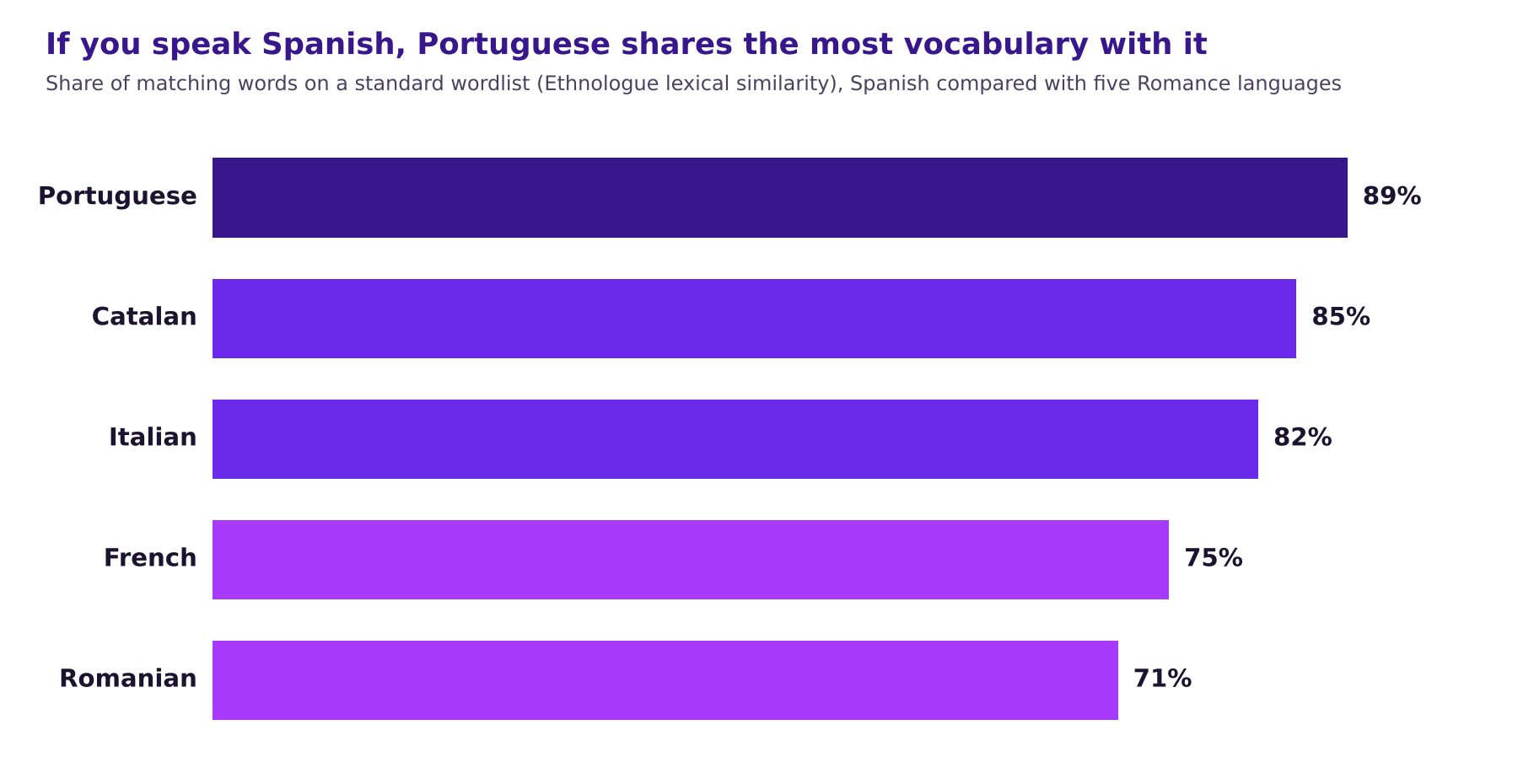
If you speak Spanish, Portuguese shares the most vocabulary with it, at 89%.
Two limits apply. The page says lexical similarity is "only one indication" of how easily speakers of two languages understand each other, since sounds and grammar matter too, and results depend on the wordlist used. And it measures closeness, not hours, so it shows which languages sit nearest to Spanish rather than how long each takes. The same wordlist table also covers Italian, Portuguese, French and Romanian, so the same method works if one of those is your first language.
Is there an easiest language in the world?
No measure we found says so. Both of the ones we opened start from a language you already speak: the State Department's from English, and the Ethnologue wordlist comparison from whichever pair you pick. The easiest language depends on where you start.
The two measures can also disagree. Ethnologue's wordlist puts English closer to German (60%) than to French (27%), yet the State Department puts French in the shortest category and German in the second. The Wikipedia page that reproduces the table says the English to French figure differs from other studies, which find a considerably higher overlap once words derived from Latin are counted. So vocabulary overlap is one reason a language feels easy, not the whole of it, and neither number is a stopwatch for your own learning.
The two measures can also disagree. Ethnologue's wordlist puts English closer to German (60%) than to French (27%), yet the State Department puts French in the shortest category and German in the second. The Wikipedia page that reproduces the table says the English to French figure differs from other studies, which find a considerably higher overlap once words derived from Latin are counted. So vocabulary overlap is one reason a language feels easy, not the whole of it, and neither number is a stopwatch for your own learning.
Where to go from here
Easy is one question and useful is another. If you are choosing between the languages above, The Most Useful Languages to Learn (and How to Pick Yours) compares them on speakers, jobs and websites. For tools to build a daily habit, see Best Language Learning Apps in 2026. And to practice with a real person once you have chosen, you can Browse our teachers.
← Back to Blog
6 min read