Is English Hard to Learn? What the Research Says About Spelling, Sounds and Grammar
SF
Scolingo Founder
8 min read
·
32 views
Published:
November 8, 2026
Updated:
November 11, 2026
English is hard in some ways and easy in others, and the evidence is clearest on spelling. Here is what the research says about spelling, sounds, verbs and grammar, how your first language changes the answer, and how many hours it takes.
Is English hard to learn? In some ways yes and in some ways no, and the evidence is clearest on spelling. English spelling is quite irregular compared with many other languages, and in a 2003 study of 13 European writing systems, children learned to read English more than twice as slowly as in the most regular ones. Grammar is the easier side: English nouns have no grammatical gender and no case endings. This guide covers what makes English hard, what makes it easy, whether your first language changes the answer, and how many hours Cambridge English says it takes to reach each level.
Is English hard to learn?
It depends on which part of English you mean and what your first language is. Spelling is the part with the clearest evidence of difficulty. Grammar is the part where English is lighter than many languages. Sounds, irregular verbs and idioms sit in between. Nobody has measured all of it on one scale, so any single "easy" or "hard" verdict is an opinion.
English spelling is the one part with measured evidence of difficulty: in a study of 13 European writing systems, children learned to read English more than twice as slowly as in the most regular ones.

The sections below take each part in turn, with the research behind it and its limits.
Is English the hardest language to learn?
No source we opened says so. The searches "is English the hardest language to learn" and "is English one of the hardest languages" have the same honest answer: no measure we found ranks English against all other languages for learners in general, because every measure starts from one particular learner's language.
The US State Department's difficulty categories, for example, are built for native English speakers learning other languages, and the pages we read do not rate English at all. The economists Barry Chiswick and Paul Miller built the closest thing to an English-as-target measure: a linguistic distance between English and other languages, based on how hard Americans find those languages to learn. They found that among adult immigrants in the United States and Canada, the greater the distance, the poorer the respondent's English proficiency. So the research points to English being hardest for people whose first language is far from it, not hardest for everyone. For the languages that are hardest for English speakers, see The Hardest Languages to Learn, According to the US State Department.
The US State Department's difficulty categories, for example, are built for native English speakers learning other languages, and the pages we read do not rate English at all. The economists Barry Chiswick and Paul Miller built the closest thing to an English-as-target measure: a linguistic distance between English and other languages, based on how hard Americans find those languages to learn. They found that among adult immigrants in the United States and Canada, the greater the distance, the poorer the respondent's English proficiency. So the research points to English being hardest for people whose first language is far from it, not hardest for everyone. For the languages that are hardest for English speakers, see The Hardest Languages to Learn, According to the US State Department.
Why is English hard to learn?
Four things are usually named, and they are not equally well supported.
Spelling
The Wikipedia article on English orthography says English has multiple ways to spell nearly every sound, and most letters have more than one pronunciation. It says the vowel sound in "through" can be spelled in up to 18 different ways, and says the letters "ough" can be pronounced in at least ten different ways: think of though, tough, cough, through, thought and bough. The article gives several reasons: a large number of words borrowed from other languages, pronunciation changes such as the Great Vowel Shift that spelling did not follow, the printing press freezing the system, and the fact that English has never had an official body regulating spelling.
The best measured evidence is a 2003 study in the British Journal of Psychology by Philip Seymour, Mikko Aro and Jane Erskine. It compared how quickly children learn to read English and 12 other European writing systems. Most children in the other languages read familiar words with over 90% accuracy by the end of their first school year. The Scottish children in the English sample averaged 34% on familiar words in their first year and were still well below 90% after two years. The authors reported that reading develops more than twice as slowly in English as in the regular systems, about 2.5 to 1.
Three limits matter. The study is about children learning to read their own language, not adults learning English as a second language. The English sample was 30 children at each of two school grades in one Scottish city, and the English children were younger when tested than most of the other groups, which the authors say could contribute to the size of the gap. And the classification of spelling depth in the paper is described by its authors as hypothetical. So it shows that English spelling takes longer to master, not by how much it will slow down an adult learner.
Vowel sounds
The Wikipedia article on English phonology puts English at about 24 consonant sounds, and says English, like other Germanic languages, has a particularly large number of vowel sounds. It gives 14 to 16 vowels for General American and 20 to 25 for Received Pronunciation, and says the counts depend on the dialect and on the way the sounds are analysed. We did not find a study measuring how this affects learners, so the claim is only that there is a lot to learn, not how hard it is.
Irregular verbs
According to the Wikipedia article on English irregular verbs, English has irregular verbs "approaching 200 in normal use", and significantly more if verbs with prefixes are counted. The same article says the dozen most frequently used English verbs are all irregular, so learners meet irregular forms from the first lessons rather than later.
Phrasal verbs and idioms
The linguist Vyvyan Evans, writing in Psychology Today in 2017, adds phrasal verbs, where a small word changes a verb's meaning unpredictably, and idioms, which cannot be understood word by word. His article cites no study for these, so treat them as informed opinion, not measured difficulty.
What makes English easy to learn?
Grammar is where English is lighter than many languages. Unlike nouns in many other Indo-European languages, English nouns do not have grammatical gender, and nouns do not take case endings: grammatical function is shown by word order, prepositions and the possessive 's. Personal pronouns (I, me, my) are where English keeps the most case marking.
The other thing in English's favor is scale. Ethnologue's 2026 edition, as listed on Wikipedia, puts English at 1,530 million speakers in total, of whom 450 million are first-language speakers and 1,090 million second-language speakers. That is more second-language than first-language speakers, and more second-language speakers than any other language in its top 15.
The other thing in English's favor is scale. Ethnologue's 2026 edition, as listed on Wikipedia, puts English at 1,530 million speakers in total, of whom 450 million are first-language speakers and 1,090 million second-language speakers. That is more second-language than first-language speakers, and more second-language speakers than any other language in its top 15.
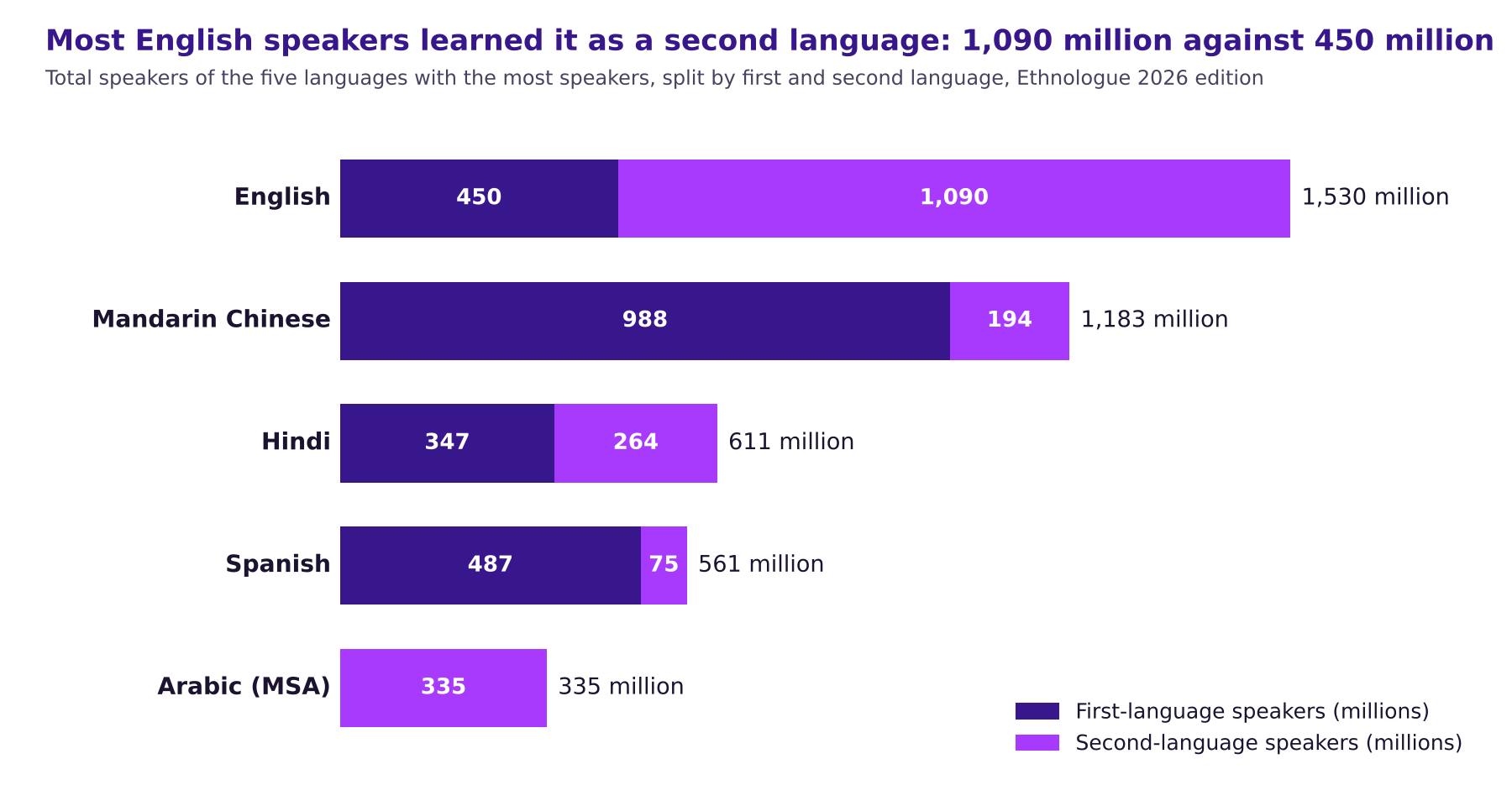
Most English speakers learned it as a second language: 1,090 million of 1,530 million.
Scale is not the same as ease. It does show that English is learned by a very large number of people, and, by our reading, that there is a great deal of material and many people to practice with: W3Techs puts English at 49.5% of the websites it tracks (1 November 2026).
Is English harder for some first languages than others?
Yes. This is the one point here that comes from a published measurement of English proficiency. The Chiswick and Miller finding above is the main evidence: the greater the linguistic distance between English and your first language, the poorer the English proficiency of adult immigrants in their sample. Vyvyan Evans makes the same point, noting that English draws heavily on French and Latin, which helps speakers of French and other Romance languages recognize words, and that speakers of languages close to English, such as Dutch or German, find it easier than speakers of unrelated languages such as Japanese.
We could not open the table of distance scores in the Chiswick and Miller paper, so we cannot rank first languages by how close they are to English. We also found no published ranking of English difficulty by first language that we could verify. If you are weighing English against another language, The Easiest Language to Learn for English Speakers, Ranked by Study Time shows the same idea from the other side.
We could not open the table of distance scores in the Chiswick and Miller paper, so we cannot rank first languages by how close they are to English. We also found no published ranking of English difficulty by first language that we could verify. If you are weighing English against another language, The Easiest Language to Learn for English Speakers, Ranked by Study Time shows the same idea from the other side.
How long does it take to learn English?
Cambridge English publishes approximate guided learning hours for each CEFR level, for learners of English. They are cumulative, counted from complete beginner, and Cambridge says moving from one level to the next takes roughly 200 guided hours. It calls the figures a guideline only, and lists your language learning background, the intensity of your study, your age and the amount of study or exposure outside lessons as factors.
Cambridge English guided learning hours by CEFR level:
Cambridge English guided learning hours by CEFR level:
| CEFR level | Cumulative guided hours | Rough meaning |
|---|---|---|
| A1 | 90 to 100 | Beginner |
| A2 | 180 to 200 | Elementary |
| B1 | 350 to 400 | Intermediate |
| B2 | 500 to 600 | Upper intermediate |
| C1 | 700 to 800 | Advanced |
| C2 | 1,000 to 1,200 | Proficient |
On your calendar, the table below is our arithmetic: hours divided by hours per day, on a 365-day year, using the top of each Cambridge range. It counts every hour as a guided hour, which a self-study hour often is not, so treat each cell as a minimum.
Time to reach each level, by hours of study per day:
Time to reach each level, by hours of study per day:
| Study time per day | B1 (up to 400 hours) | B2 (up to 600 hours) | C1 (up to 800 hours) |
|---|---|---|---|
| 30 minutes | about 2.2 years | about 3.3 years | about 4.4 years |
| 1 hour | about 1.1 years | about 1.6 years | about 2.2 years |
| 2 hours | about 7 months | about 10 months | about 13 months |
| 4 hours | about 3 months | about 5 months | about 7 months |
How to spend those hours, and what research says about spacing and testing yourself, is in How to Learn a New Language (and How Long It Takes).
Where to go from here
If English is your target, the evidence we found says to expect the difficulty in spelling and sounds more than in grammar. For tools to build a daily habit, see Best Language Learning Apps in 2026. And to practice English with a real person, you can Browse teachers.
← Back to Blog
8 min read